The comic and its plot
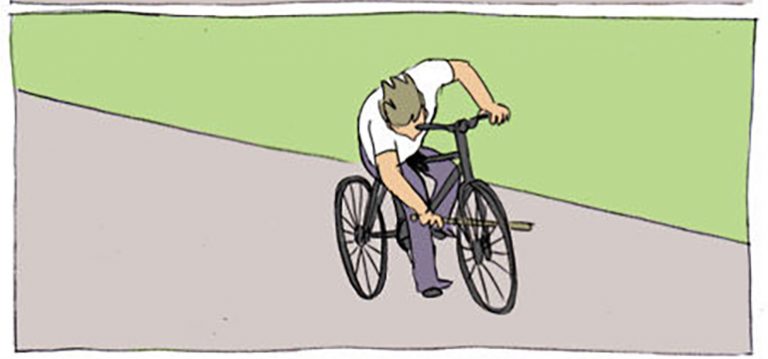
The meme is based on a short three-panel comic. In the first panel, a boy rides a bicycle along a road beside a green slope. In the second, he reaches toward the wheel with a stick, and in the third he falls. The simplicity of the plot makes it possible to follow the story without any words. The plot rests on anticipation: the viewer watches the character make a decision and understands the consequences before they're shown in the third panel.
The drawing is done in a calm, flat style with soft colors and no pronounced detail, which heightens the comedy of the situation. The character is neither a villain nor a hero, just an ordinary child performing a pointless action. The color palette barely changes from panel to panel, which underscores that nothing of consequence is happening around him besides the character's own actions.
Origin
The name "Baton roue" points to the French language, and there are grounds to believe the comic was created in a French-speaking environment. However, the author, the year, and the platform of first publication are not known. The meme dates to 2011, when comics of this format were actively circulating on social networks and blogs. The combination of a French title and a Russian translation is characteristic of many early internet images, which passed from one community to another along with captions and translations.
The comic quickly acquired a Russian-language name, and the audience began using it as a ready-made illustration for the idiom "to put a stick in someone's wheels" (the Russian equivalent of "to throw a spanner in the works"). The idiom has long existed in the Russian language, and the comic simply gave it a vivid image that could easily be inserted into any argument or discussion.
Meaning in speech
In conversational speech the meme is used to mean deliberately hindering someone, including oneself, from achieving a goal. For example, if a coworker deliberately drags out a task and then complains about the deadline, people in a discussion might write "a stick in the wheels" and attach the picture of the boy.
An important nuance is self-irony. The comic is often applied to a situation where a person creates difficulties for themselves and then is surprised by the result. The self-irony here lies in the fact that the speaker acknowledges their own role in the mishap and turns it into a joke rather than shifting the blame onto others.
Spread
The meme spread through blogs, comments, and forums, where short comics served as a convenient illustration. The three-panel format made it possible to share the image quickly and pair it with any caption. The picture also traveled easily through messaging apps, since it took up little space and could be read in seconds even when opened on a small screen.
Over time, reworked versions appeared, replacing the boy with familiar characters or changing the object stuck in the wheel. Such variants kept the structure of the story but changed the context.
Cultural context
The image of an obstacle a person creates for themselves appears across many cultures, and this comic fits well into that lineage. Its simplicity and clear plot helped the meme survive its wave of internet popularity and settle into everyday speech. Many languages have similar expressions about people getting in their own way, and for Russian-speaking audiences the meme became a convenient, short way of saying exactly that.
Today the meme occasionally appears in retrospectives of old internet comics as an example of how a visual metaphor turns into a fixed expression.