What the image shows
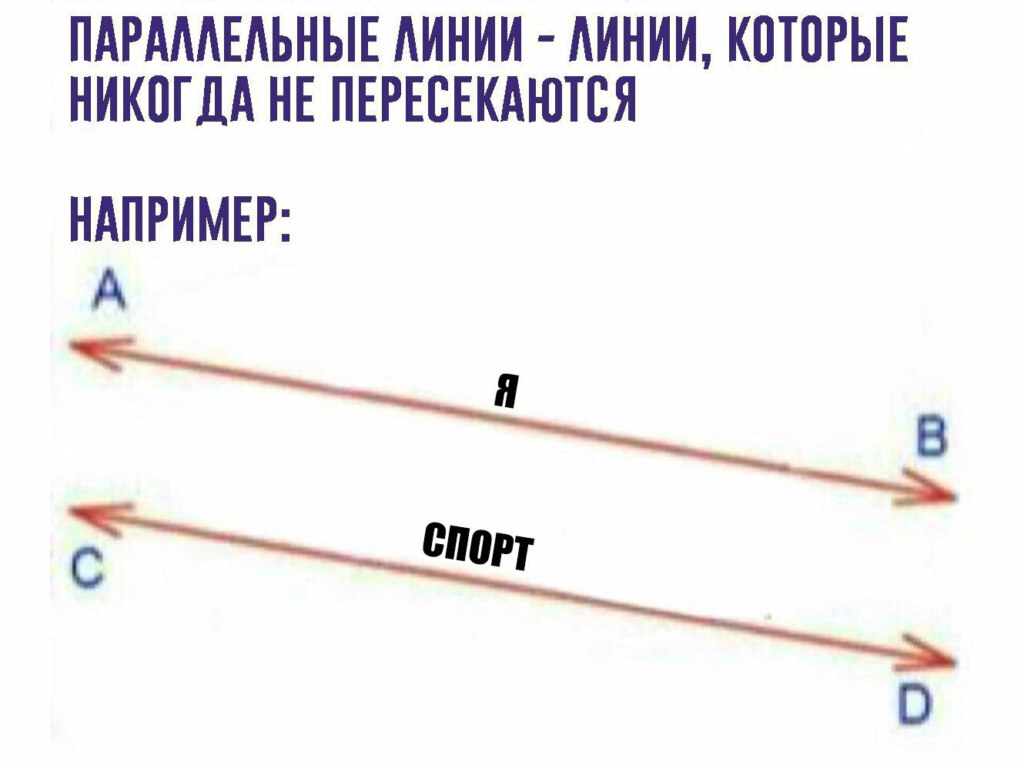
The picture is split into two parts. At the top, in large purple-blue type, is the definition: “Parallel lines are lines that never intersect.” Below is the phrase “For example:” and two line segments with arrows, labeled A, B, C, and D. The upper line is marked “Me,” the lower one “Sports.” The diagram is styled like a geometry textbook, with red arrows, and this visual precision makes the joke recognizable at a glance. The heading is set in all caps, like the covers of school workbooks or posters, so the formal tone contrasts with the everyday caption.
How the joke works
The joke rests on two assumptions. First, the definition from school geometry is correct: parallel lines on a plane indeed never intersect. Second, the idea of intersection carries over to human relationships and activities. When one line is labeled “Me” and the other “Sports,” the viewer understands that the speaker has no point of contact with sports, meaning they don't do it. The caption sounds neutral and scientific, but in substance it confesses to laziness. This device rests on the gap between an official tone and an everyday admission, and that is what makes the format suitable for self-deprecation.
Origin and dating
The meme dates to 2018, but the picture’s author and the date of first publication are not known, so the origin remains unestablished. Jokes with a similar structure, where a scientific definition is matched with everyday notions, have existed for a long time, but it cannot be determined which specific version gave rise to this particular picture.
How the format is used
The format's main feature is substitution. The two-line scheme and the letters stay, while the labels change. Illustrative variants could be “Me” and “Monday,” “Me” and “Deadline,” or “My couch” and “A walk.” Every version works the same way: two things that, by their meaning, will never meet. The format is usually used in comments, when someone wants to jokingly admit they are far from a certain activity or phenomenon. The template itself contains no insults and isn't aimed at any particular person, so it suits a broad audience without risk of offending anyone.
Why the picture endures
The format is recognizable without explanation. The textbook diagram, the strict type, and the even line of arrows create a contrast with the mundane caption, and the viewer gets the joke in a second. Geometry is part of the school curriculum, so almost any reader understands the definition and immediately relates it to their own experience. The format is not tied to an event and doesn't require knowledge of a specific film or game, so it can be used for years. Unlike memes tied to a news hook, this template outlives its own context and stays clear years after it appeared.
What to clarify in the catalog entry
The catalog entry describes the pair as “person and sports.” In the picture itself the label reads “Me,” so it is in the first person rather than about people in general. This is an important distinction: the joke reads as a self-admission, not as a generalization. The entry also doesn't explain why the word “sports” was chosen as the second concept. That detail can only be understood from the wider cultural context, in which sports is often set against laziness. Precise wording helps convey the picture's tone without distortion.