What the four panels show
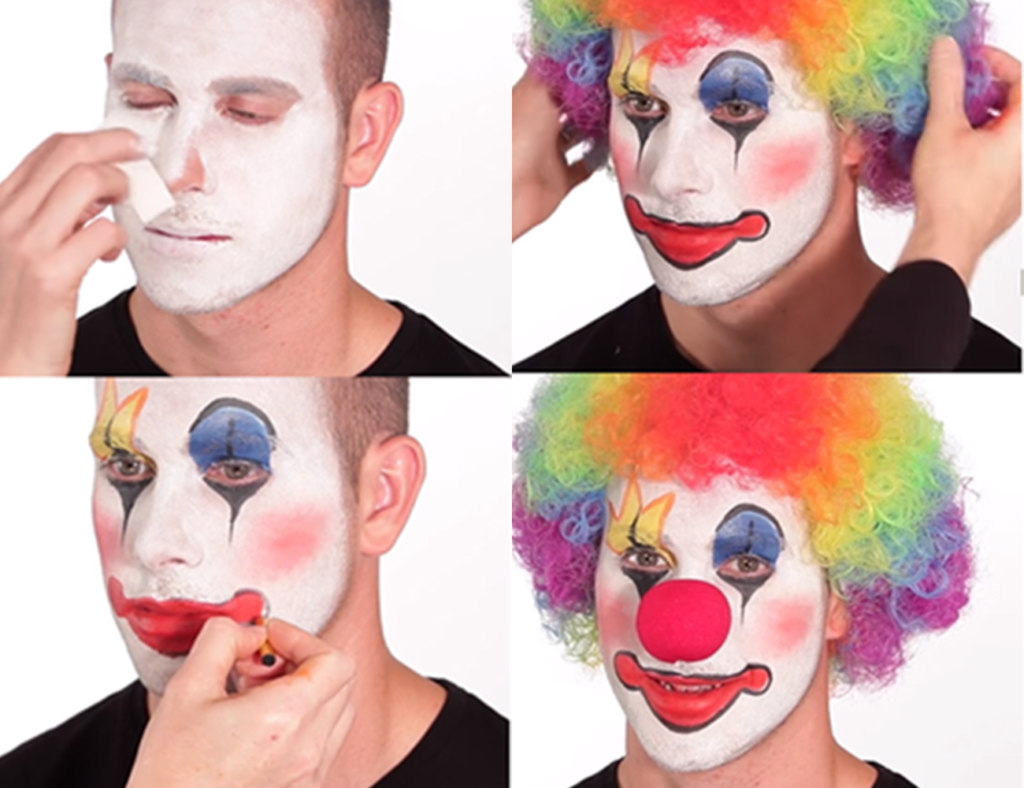
The collage is split into four equal parts. In the top left, a young man with his eyes closed has his face half covered in white base, while someone’s hand applies makeup near his nose with a sponge. In the top right, the face is already fully white with blue shadows, black tears under the eyes, a red mouth and blush, and two hands are straightening a multicolored wig. In the bottom left, there is no wig yet, and red paint outlines the lips. In the bottom right, the look is complete: a round red nose, a wide red smile, and a wig in rainbow tones.
The meaning reads without words: each next frame adds more absurdity. The last panel is the result of the chain of decisions that leads to it.
Where the template came from
The source material is the instructional video “Male Clown Make-up Tutorial” from the costume shop Smiffys, published on YouTube on 28 October 2015. It is an ordinary makeup tutorial, and it was never meant as a meme.
According to accounts, the first joke based on these frames was made on 21 May 2019 by a Facebook user, and the template became widely known on 13 June 2019, when a version about arguments over Pokémon in Pokémon Sword and Shield appeared on Twitter. The pattern later spread to all sorts of topics, from politics to games and everyday disputes.
What the joke means
The clown makeup is a metaphor here. Each stage is another argument, act, or decision that a person considers reasonable, but which together make them comical. The final red nose marks the point where self-deception becomes obvious to everyone except the hero himself.
An important feature of the format is its gradual build-up. What is funny is not that the person ends up a clown, but how methodically and happily they add details. That is why captions built from four logical steps work better than one general phrase.
Example captions
Most often, each panel gets its own line, and the last one gets the most absurd. Made-up examples.
“Argued with a stranger in the comments” → “Cited statistics” → “Wrote a three-screen paragraph” → “Waiting for them to admit they were wrong.”
“Bought a gym membership” → “Bought the outfit” → “Downloaded a workout plan” → “Starting on Monday.”
“Went to bed early” → “Set an alarm” → “Opened one more episode” → “Waking up at six in the morning, smiling.”
“Decided to tidy up the desk” → “Took out all the stuff” → “Found an old photo album” → “Two hours looking at photos.”
How to use the template
The template works best as self-irony: caption it with your own habits and recurring mistakes. If you aim it at other people’s opinions, the joke easily turns into an insult, especially when real people or serious topics are involved. Remember that the man in the photos is only a performer in a tutorial video and has nothing to do with the jokes built on him: laugh at the logic of the argument, not at him.
Stick to the logic: each following panel should be a little more absurd than the previous one, and the last one the most absurd. Short captions on the frames read faster than long explanations and keep the rhythm of the template.