What the picture shows
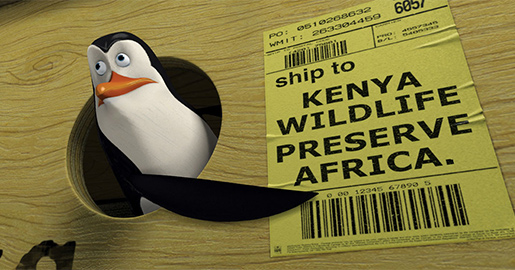
A close-up of a cartoon penguin with black-and-white plumage and an orange beak. It peers out of a round hole in a light wooden wall that resembles a shipping crate. Its eyes are wide, its brows are raised, and its expression is wary. One flipper is stretched to the right, as if pressing against a large yellow label.
The label has the words “ship to” printed in large black letters, with “KENYA WILDLIFE PRESERVE AFRICA” below. A barcode and service numbers are visible under the text. The result is a ready-made composition: a character, a pointer, and a blank field for meaning that the viewer reads at a glance.
Where the frame comes from and what is not known about it
The penguin and the shipping label with an African address point to DreamWorks' animated film “Madagascar,” in which animals are shipped by sea to a nature preserve. Reports say the frame comes from the 2005 film, but the exact scene and which of the four penguins appears in it have not been established, and the character's name remains unknown.
The origin of the meme itself is also not established: it is unknown who first cut out this frame and when the first caption joke appeared. It is also unclear how long the template has been circulating online. This does not get in the way of using it: the picture works as a standalone gesture and does not require knowing the plot of the film.
Why the gesture works
The joke rests on an overly explicit hint at the obvious: the flipper points right, the viewer's gaze follows the same direction, and the label takes up half of the frame, where text usually goes. The penguin seems to say: here, just read it. If the caption is banal, a comic gap opens between the solemnity of the gesture and the trivial content.
The words on the label add a further layer: a shipping address implies that someone has already been delivered to their destination. Captions built on the theme of “what you needed was already written down” gain a second layer from this: everything necessary was said, nobody just read it.
The penguin's expression also changes the tone of the pointing: it is unsure and slightly alarmed, so the gesture looks less like a lecture and more like a timid hint, which lets the caption be delivered as a gentle reproach.
Caption examples
Below are several invented captions. All of them follow one pattern: briefly name the thing the penguin points at, and let the phrase sound like a discovery.
“The Wi-Fi password you asked me about three times is on the sticker under the router.” The sticker in the picture and the sticker in the caption match in meaning, so the subject of the joke seems to be drawn right into the frame.
“The assembly instructions for the wardrobe were in the box.” A detail familiar to everyone, and the crate in the frame strengthens the association with unpacking.
“The meeting start time was in the invitation.” A work situation where the answer really is in plain sight. The contrast between the serious gesture and a trivial thought makes the joke.
“File name: final_final_edit_2.” Here the flipper's pointing turns into a reproach aimed at oneself: a shared laugh at a habit everyone knows.
How to choose a caption
A short phrase that can be read in one second works best. If the text grows, the gesture loses its point, because the penguin is pointing at one detail, not at a paragraph. A good caption names a specific object: a password, instructions, a date, a button.
Everyday situations with light self-irony, work reminders, and answers to questions that already have an answer all fit well. Captions where the pointing is directed at a person work less well: the joke then becomes a reproach rather than a shared observation.
If the text should go not over the sticker but beside it, it is better to keep the right side of the frame clear: the sticker already serves as a frame, and extra text on top of it hurts readability. The image can be cropped slightly at the edges, but the penguin's head and the extended flipper must stay in the frame, otherwise the gesture itself is lost.