What's in the picture
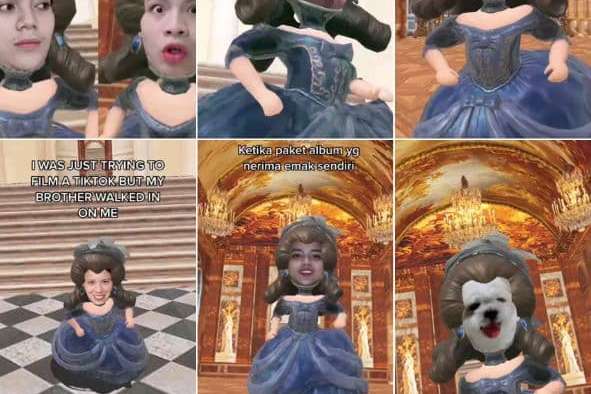
The picture is a collage of six frames. The top ones are close-ups: people's faces inserted into the figure, and a lush, deep-blue skirt shaking as it runs. Below are wide shots: a black-and-white checkered floor, gilded walls, and crystal chandeliers in a palace hall. The figure is a cartoon woman with a tall, dark-curled updo, onto which someone else's face has been "attached"; in one frame, a white dog's muzzle stands in for a human face.
Several frames carry overlaid text: one caption is in English (a person supposedly filming a video while their brother walks into the room), another is in a different, apparently non-Russian language. These are ordinary captions that creators added on top of the video to set up the situation.
Timeline: from museum effect to trend
The effect was released on TikTok as part of a museum-themed promotion (#MuseumMoment) and showed the user, cast as Queen Marie Antoinette, running through a virtual gallery of the Palace of Versailles. This is stated in the platform's own announcement from May 27, 2021.
According to an English-language reference source, the effect appeared during the week of May 17, 2021, with the first notable videos dated May 19. Who shot the very first video is unknown. One TikToker reportedly racked up around 17 million views in four days according to the earliest figures, and a video re-enacting the run physically gained tens of millions of views in a single day. These numbers come from a single reference source and may have grown since, so they should be treated only as a rough benchmark.
The sound and the discrepancies
The main audio track is a remix of Lady Gaga's "LoveGame," made by musician Drew Stevens in 2014. A separate sound by a TikToker named Gil is also mentioned; his role isn't confirmed by independent sources, so that detail should be treated as unverified.
The name "Escape from Versailles" is the Russian-language version; the original is called the Versailles Run.
How the joke was built
The core formula is simple: against the backdrop of a panic-stricken young woman running in a ball gown, the user describes a situation they'd like to run away from. What makes it work is the mismatch in scale: a minor everyday annoyance (a neighbor started drilling, a package went to the wrong address) collides with the high drama of a palace escape.
The second mechanism is the animation itself. The figure runs awkwardly, bouncing as it goes, and someone else's face on its body makes it grotesque. This is a case where the effect itself is funny with no caption at all, and the text only steers the associations.
Example captions
"Me, when I heard I had to file the report by end of day." The ball gown underscores how theatrically oversized the reaction is for a work task — hence the laugh.
"The cat saw the vacuum cleaner." A pet-themed variant, where an animal's muzzle replaces the face, as in the dog frame on the collage: the double transformation amplifies the absurdity.
"When someone in the group chat wrote 'we need to talk.'" The panic is total, the cause unknown — the viewer fills in the worst-case ending themselves.
"My life plans, the moment the bill arrived." A short, instantly recognizable situation: running with the skirt in hand as a metaphor for fleeing from a bill.
Tips for using it
The six-frame image works well as an illustration for a piece about the trend or as a reaction to someone's story. For a static caption, it's better to take a single frame from the video where the blue hem is visible, rather than the whole collage.
Remember that this was originally a moving format with sound: without the music the joke is weaker, so the image needs a caption that explains the flight on its own.