Rainbow circle and square
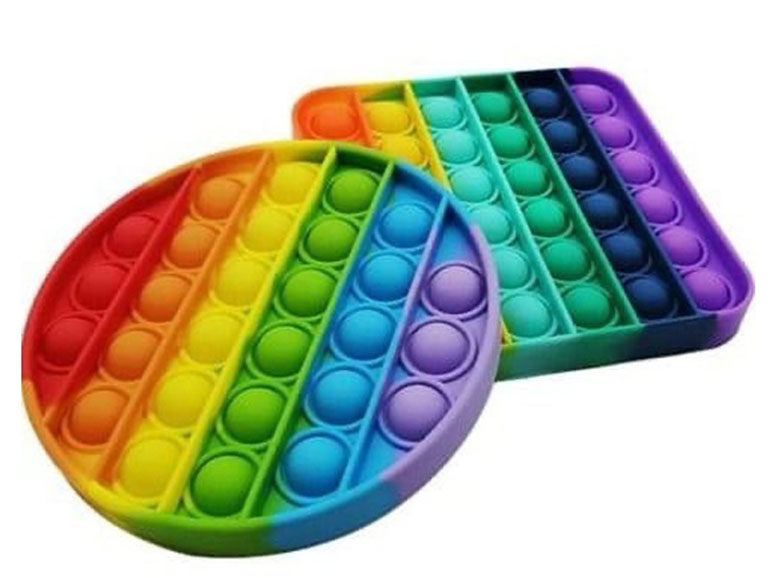
The photo shows two silicone Pop Its, one round and one square, both in rainbow colors. The colors run in stripes: red, orange, yellow, green, light blue and purple, and the square one also has blue and darker shades. Each stripe is made of round raised bubbles that press inward with a light click. The toys lie on a white background, one partly overlapping the other.
This is a product illustration, not a joke: there is no caption or storyline. The meme comes from the associations around the object.
How the toy caught on
According to an English-language reference, a similar toy was invented in 1975 by Israelis Theo and Ora Koster. In 2009 the rights passed to the Canadian company FoxMind, which switched to silicone; in the US the toy reached Target stores in 2019. These details should be checked against the companies' own publications.
Mass popularity came in 2020–2021 through TikTok: clips of popping bubbles, reviews and “collections” racked up views, and the pandemic added demand for anything that keeps your hands busy. According to Russian coverage, in May 2021 searches for “simple dimple” jumped many times over, and Pop It prices rose several times within a month to 200–300 rubles.
Pop It vs. Simple Dimple
A Pop It is a large flat tile with rows of bubbles. A Simple Dimple, according to Russian reviews, is a smaller keychain version with fewer bubbles. In practice the names are often confused and used as synonyms, and in memes they are almost never distinguished.
Both toys work on the same principle: you press a bubble, flip the tile and press from the other side, until all the bubbles are pushed in. The game has no goal and never ends in a win, which is both its appeal and a source of jokes.
What people joke about
There are three main angles. The first is the mass craze: everyone pulls out a toy in class, on public transport and at work, and then jokes about it the way people once joked about fidget spinners. The second is the pointlessness of it: the whole point is to keep pressing. The third is the promise of “benefits”: specialists quoted in a Russian review noted that such toys distract from anxiety more than they treat it.
So jokes often pair a serious tone about a problem with an absurd solution: “nothing will help except one more row of bubbles.”
Caption examples
“Deadline in an hour, and I'm on my second round of all the bubbles.” A contrast between urgent work and a pointless activity.
“The psychologist said to find a way to cope with stress. I found one. I bought a fifth Pop It.” A joke about collecting as a solution.
“When the last bubble didn't pop on the first try and my whole picture of the world collapsed.” A small failure inflated into a tragedy.
“Squid Game for people with no nerves.” The caption references another 2021 trend and mixes two familiar things.
Tips for using it
The image suits captions about distraction, anxiety, procrastination and fashionable crazes. The rainbow colors work best as a backdrop for a “cheerful” mood: the darker the text, the stronger the contrast.
Do not promise a therapeutic effect in captions. It is a toy, and research does not show that it treats stress.