From board game to parody box
Connect Four went on sale under the Milton Bradley brand in 1974. Two players take turns dropping discs into a vertical grid; the goal is to line up four of your own pieces before your opponent does. The simple description of the rules made the title easy to rework: it is enough to change a number or the last word, and the result looks like a new game.
Parodies existed long before the wave of the mid-2010s. Among the known early traces is Connect One, circulating in 2007, where the goal was cut down to a single piece. In March 2016 a variant called Connect Flour appeared on Reddit, in which the English “four” was replaced with the near-homophone “flour.” By 2018 the images were being collected into compilations and kept being altered. These dates refer to the internet remakes; the year the children on the box were photographed is not separately established.
Advertising joy up close
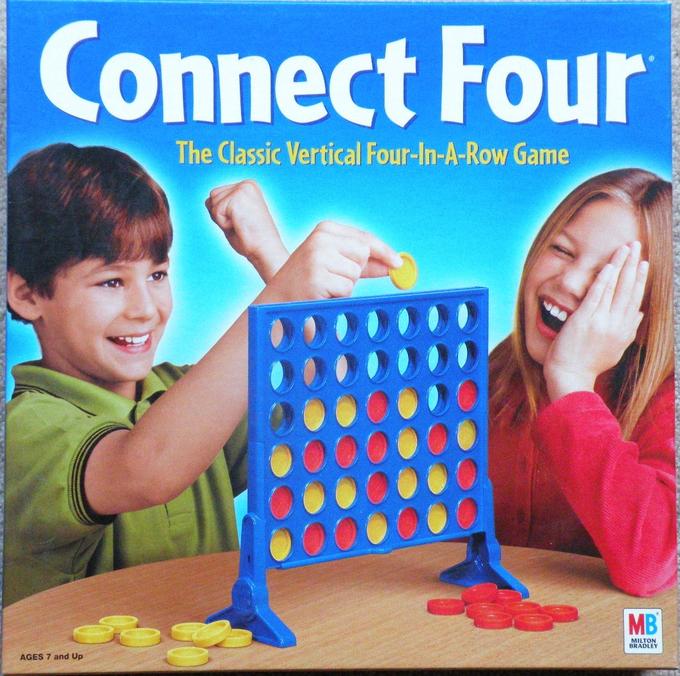
On the blue packaging, “Connect Four” is written in large letters across the top. The boy on the left, in a green shirt, holds a yellow disc above the grid and smiles. The girl on the right, in a red sweater, laughs, her palm raised to her face. In front of them stands a blue game frame, partly filled with red and yellow pieces; the remaining discs lie on the table. In the corner there is an MB mark, and at the bottom an age notice of seven and up.
In this version the title and the contents of the box are ordinary. The meme arises from the possibility of remaking the packaging, not from an already drawn strange game. The wide smiles and raised hands create the promise of enormous fun. When an unexpected object replaces the familiar discs, that convincing joy remains and starts to look completely out of proportion to the activity.
The box makes even the absurd convincing
The remake imitates a finished product. The bold headline, the brand corner and the photo of the participants help one imagine that the ridiculous pastime is actually sold on shelves. The author may change just one word, while the rest of the packaging seems to vouch for its seriousness. The humor lies not simply in the strangeness of the idea, but in seeing it pushed with such determination.
The second mechanism is the removal of difficulty. Connect One promises victory almost immediately, yet the boy and the girl react as if they had survived the tense final of a tournament. The meme mocks the gap between the scale of the action and the triumph. This is not evidence that the real Connect Four lacks strategy: the mockery is aimed at the invented, simplified rules and at the expressive staging of the photograph.
The variants built on near-homophonic English words add a linguistic puzzle. The new title explains the new object, and the object helps decode the pun. Even without a long instruction, it is enough to see the headline and what now lies where the pieces should be. The advertising frame turns the wordplay into a small object-based scene.
What else could go in the grid
Imagine a fictional box called “Connect Socks.” Instead of discs, socks of different colors lie on the table, and the boy drops a lone striped item into the grid. The girl rejoices on discovering a pair. A familiar pose sells as an exciting tournament an activity that usually ends with the question of where the second sock went.
In another remake the title becomes “Connect Chargers.” The blue frame is filled with multicolored cables, and the participants celebrate finding a matching connector. Victory means that one phone can finally be plugged in. The joke draws on a genuine household muddle, but gives it the form of a boxed game with fun promised in advance.
The third variant is “Connect Weekend Plans.” Small cards with activities are placed in the holes, and the happy boy holds an empty card. It symbolizes the only free hour. The caption turns the absence of plans into a winning move, and the girl’s laughter into a festive reaction to the result. All three scenes are fictional; what unites them is the preserved advertising expressiveness, which makes the new object implausibly attractive.