What the picture shows
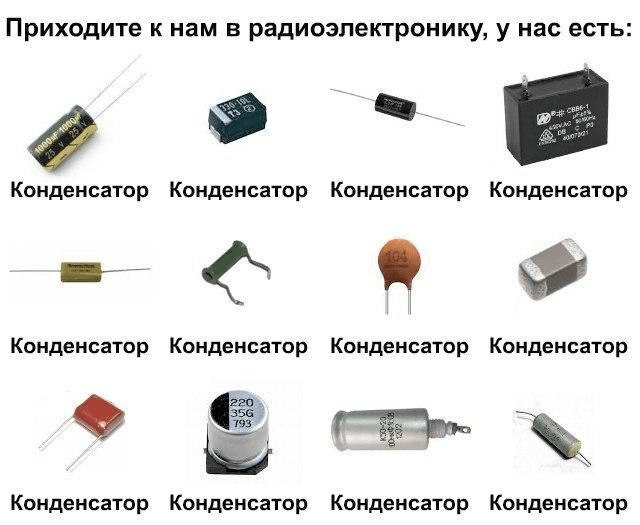
At the top is the line: “Come to us in radio electronics, we have:”. Below are three rows of four parts each, and under each one, in bold type, is the word “Capacitor.” Visible are black cylinders with capacitance markings, flat rectangular housings, an orange disc element marked 104, small ceramic “bricks” for surface mounting, a red film housing, a metal housing of the Soviet type, and components with leads of different lengths.
An important detail: the caption doesn't lie. All of these parts really are capacitors, just of different types. So the joke is built not on a mistake but on an outsider's view: to a newcomer they look completely different, yet each is labeled with one word.
Why capacitors look so different
A capacitor stores electrical charge, but it is built differently depending on the task. Electrolytic capacitors look like cylinders and are rated for large capacitance. Ceramic ones come as discs or tiny chips, and film ones as rectangular little boxes. Surface-mount housings are soldered directly onto the board without leads.
The numbers on the housing are read by rules. For example, on the ceramic element marked 104, this means 10 times ten to the fourth power picofarads, that is, about 100 nanofarads. It is nice when a meme makes you look at such details.
The “Come to us, we have” format
The template copies the manner of an advertising pitch: “come in, we have a selection.” Instead of the promised variety, you see a set of parts that look different but share the same name. The contrast between the advertising tone and the dry caption creates the funny effect.
The exact origin of this particular picture and the date of its first publication have not been established, so it is better not to attribute a specific year to it. The format itself is quite universal and suits any field where one term covers dozens of varieties.
Who the joke is for
Electronics engineers and radio amateurs laugh in recognition: for them, capacitors really do come in hundreds of types, and the question “which one exactly do I need?” is familiar to everyone. Outsiders see something else: a pile of identical words hiding the variety.
That is why the joke works both ways. For a specialist it is friendly self-irony about their field; for a newcomer it is confirmation that someone else's profession is more complicated than it looks.
Caption examples
“Come to us in programming, we have: Framework, Framework, Framework.” A hint at endless libraries that solve one task.
“Come to us in the office, we have: Meeting, Meeting, Meeting.” A work calendar where different meetings are all called the same.
“Come into the kitchen, we have: Pot, Pot, Pot,” under a photo of pots of different sizes. A household version that needs no special knowledge.
“Come to the sneaker store, we have: White sneakers…” A joke about a collector who owns fifteen almost identical pairs.
How to use it
It works well when the caption keeps the contrast: different pictures, one word. You need a grid of several variants, and it is best not to change the word under each one.
You don't need to know electronics: it is enough to take a field you know and find a concept in it that hides many varieties. The more precisely the subject is chosen, the funnier the joke will be for those who know that topic.