The nostalgic picture gets an answer
One of the known early traces of the family is a post on Angelisms from October 1, 2013. In it, children playing in a river were contrasted with a trio of children with phones. The phrase about a happy past invited readers to treat the left scene as a good childhood and the right one as its modern replacement. The collage spread with a serious attitude toward the comparison; in the Bluebird magazine in autumn 2016, an editor even discussed it as an illustration of change seen on social networks.
Parodic replacements of the left picture already appeared in April and May 2016. Instead of an idyllic childhood, unpleasant or absurd activities appeared there, though the grateful tone was preserved. A new wave of remakes spread in June 2018 on 9Gag, Reddit and other social networks. What became funny was the very rule “old is better than new,” which the caption kept confidently applying even to images that undermine its conclusion.
The same children, two sets of screens
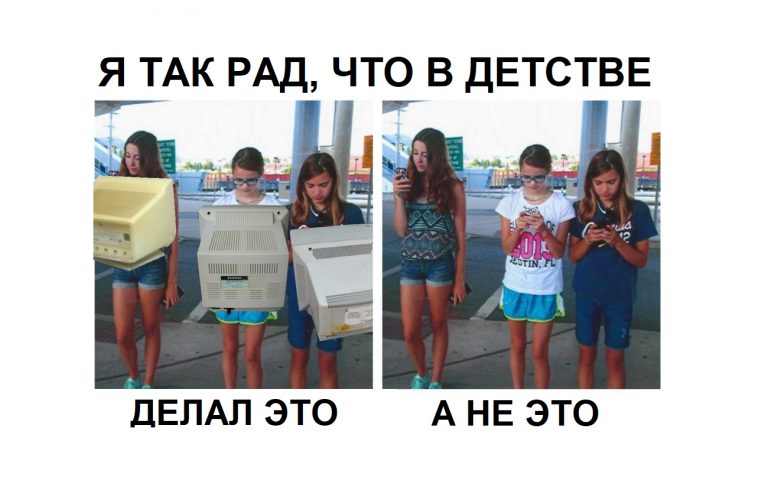
At the top it reads “I'M SO GLAD THAT AS A CHILD.” Below are two pictures of the same trio of children: clothing, poses and street background match. On the right they look at phones. On the left, over the same figures, three large computer monitors with light-colored casings have been added. At the bottom are the continuations of the phrase: “DID THIS” on the left and “NOT THIS” on the right. The river and outdoor play are absent in this version.
The monitors cover a significant part of the bodies, turning small devices into bulky objects. The rear surfaces of the casings are visible, so the viewer easily recognizes older-style equipment. The matching photographs emphasize the editing: in front of us are not two generations photographed in different years. Almost everything has been left as it was, except the screen sizes. Thanks to this, the argument about childhood reduces to a comically narrow difference that is hard to accept as proof of a better life.
The caption argues with its own pictures
The format has pre-assigned judgments. The left half is declared a good past, the right half a dubious present, and the speaker expresses pride in belonging to the first. The parody keeps this confidence and changes its basis. If two scenes show the same enthusiasm for screens, the nostalgic praise begins to sound like a preference for a huge casing over a small one, rather than a serious argument about the quality of childhood.
This version does without a shocking object: what is funny is the artificial difference between almost identical actions. The editing makes a familiar activity physically absurd — computer monitors seem to be held in front of you on the street as easily as phones. The word “this” helps the substitution, since it does not name the action and allows a new picture to be inserted each time. The phrase keeps the appearance of a finished argument, while the image shows how arbitrarily the occasion for a self-satisfied comparison has been chosen.
Three invented parodies of the past's advantage
In the first example, on the left a person goes for a walk with a large TV and a long extension cord; on the right, with a tablet. The caption still thanks fate for the left option. Attachment to old technology turns out to be so strong that inconvenience is declared a virtue.
Another invented montage compares a heavy folder of printed memes with viewing the same pictures on a phone. The content stays the same, while heroic nostalgia defends only the way of carrying it. A third variant shows, on the left, the tangled cables of three game controllers; on the right, a loose wireless one. The enjoyment of gaming is the same, but the grateful phrase chooses the extra hassle. Such examples explain the parody through the mismatch between the assessment and the objects, without turning a photo of children into evidence of their real habits.