What the screenshot shows
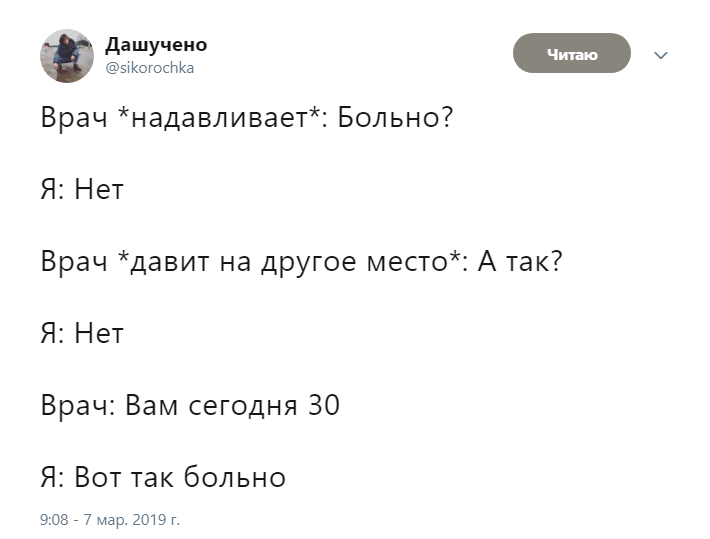
This is a screenshot of a Twitter post: in the upper left corner is the author's avatar and name, and at the bottom the time and date — 9:08, March 7, 2019. The picture contains only text, with no photos of people. The author's name is not given: this is a private individual, and the joke doesn't need it.
The text consists of six lines. The doctor “presses” and asks: “Does it hurt?” The narrator, labeled “Me,” answers: “No.” Then the doctor “presses a different spot” and repeats the question: “And this?” The answer is again “No.” After that the doctor says: “You're 30 today,” and the last line, “That's how much it hurts,” shows that the pain was not bodily.
Where the formula came from
The date on the screenshot confirms that this post has existed in this form since that day. However, this is not proof of the first publication: earlier versions cannot be established, so the origin of the format remains unknown.
The scheme itself has long been familiar: a dialogue at the doctor's, where the questions revolve around pain and the answer turns out to be something entirely different. Such a joke relies on the expectation of a normal medical examination, and each line supports that expectation so that the ending is a surprise.
How the twist works
The joke rests on expectation. The first two questions set a physical meaning: the doctor is looking for a painful spot, and the reader tunes in to an ordinary examination. Each “No” rules out a physical cause, and only one conclusion remains.
The third line changes the subject. “You're 30 today” is not a diagnosis or a procedure but a mention of age, and it is precisely this that the narrator takes painfully. The last line joins two meanings of the word “hurts”: the physical one, which the doctor did not find, and the emotional one, which the doctor found in a single phrase.
Doctor and patient are roles here rather than specific people, so the text easily transfers to any situation where an everyday remark hurts more than physical pain. The joke is built on the narrator's self-irony, not on mockery of another person.
Examples of captions
Below are three invented variants. All rest on one structure: a question about the body, a refusal, another attempt and an everyday blow.
“Doctor: Does it hurt? Me: No. Doctor: And this? Me: No. Doctor: Your vacation is over. Me: That's how much it hurts.” The change of subject happens in one short phrase, and the word “vacation” works as a concrete reason for sadness.
“Doctor: Reflexes normal? Me: Yes. Doctor: Today is Monday. Me: Now that really hurts.” The doctor looks professional, and the cause turns out to be mundane.
“Doctor: And here? Me: No. Doctor: Your coffee went cold. Me: That's how much it hurts.” A small thing in place of a big one: a device that makes the dialogue funny without exaggeration.
How to use the formula
It works best with a short one-phrase ending: the longer the explanation of the pain, the weaker the effect. The doctor's first questions are best left unchanged, which keeps the rhythm of repetition, and only the last blow changes.
The formula suits everyday annoyances and reflections on age, but not other people's misfortunes: the center remains self-irony, and the joke loses its point if the pain is attributed to a real person.