Structure of the template
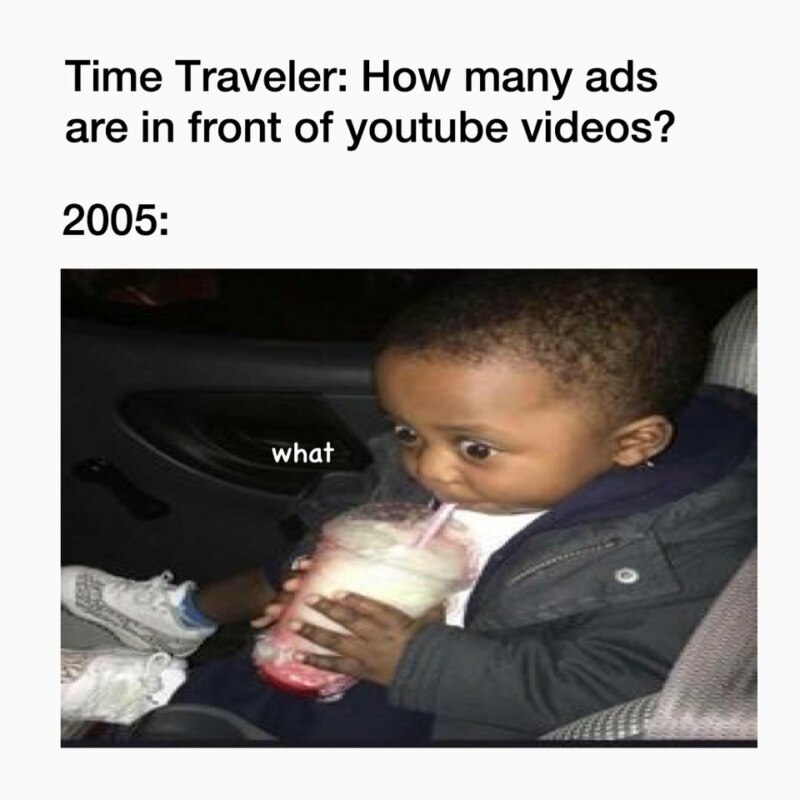
The classic form of the meme is a short imaginary dialogue: a line “Time Traveler:” with a question that sounds mundane today, and the reply of a character from an earlier year who does not understand the question at all. In the picture, the traveler asks how many ads play before videos on YouTube, and the figure labeled “2005” answers with a bewildered “what.” In 2005 YouTube itself was only launching, and ads before videos were unthinkable.
The format is built on the contrast between a detail familiar today (pre-roll ads, subscriptions, internet services) and a time when such a thing simply did not exist, so the interlocutor’s reply looks comically naive.
Reaction image
The picture uses a photo of a child with a two-spout “cocktail” pacifier in a car, captioned “what,” which has been widely circulated on the Runet (the Russian-language internet) and in the English-speaking segment. The frame existed as a standalone reaction image for expressing extreme bewilderment long before this particular meme. Its origin as a separate photo (presumably taken by one of the relatives and later spread across social networks) is not reliably documented: the frame is described as “known since the early 2010s” without naming an exact author or first publication.
What matters is that in the “time traveler” template this image serves as a ready-made visual stamp meaning “I don’t understand what you’re talking about,” not as a story in its own right. The child in the photo is not the author of the joke and has no connection to its subject.
When the dialogue format emerged
The idea of a joke about a time traveler who surprises a person from the past with a mundane detail of the future, or instead frightens them with a spoiler, has been used in internet humor before in various forms, from text jokes to comics. The specific text frame “Time Traveler: [question] / [year]: [bewildered reply]” took hold and began to spread widely in English-language public pages in the second half of the 2010s, and by 2019 it reached Russian-speaking meme communities, where people started captioning it in their own way.
Typical joke examples
Besides the YouTube ads version, dozens of variations are made on the same template: “Time Traveler: do you have a separate remote for each device in your home? / 1990: what,” “Time Traveler: how much does an apartment cost in your city? / 2010: what.” The logic is always the same: a detail that has become normal today is presented as something unimaginable for an earlier time.
Users also make the reverse move, scaring the past with spoilers of the future instead of mundane details: “Time Traveler: in ten years the show still won’t have finished filming / 2015: what.” The construction stays the same; only the reason for surprise changes.
Why the meme stays alive
The format is not tied to a specific event or public figure, so it is easily reused for any topic: technology, prices, fashion, politics. The ready-made pair “a question from the future, bewilderment from the past” needs no explanation and works like a constructor into which any new detail can be inserted, which explains its long life across different language segments of the internet.