What is in the image
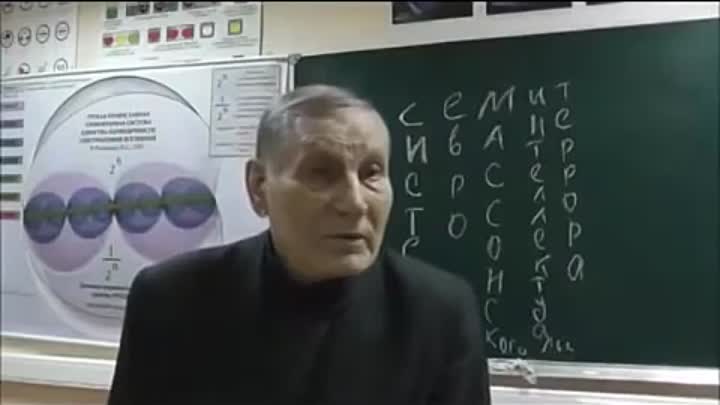
The frame shows an elderly man in a dark jacket standing in front of a green school board. Written on the board from top to bottom in colored letters is a long chain-word assembled from multicolored syllables (“sistr,” “evro,” “mass,” “intellekt,” “terror,” and so on). A poster on the wall to the left shows two overlapping circles with captions about a certain “system of commensurability.” The setting is an ordinary school or lecture room, and the video was clearly shot on an amateur camera.
The video quality is low: the picture is compressed and slightly blurred, typical of footage filmed from a screen or re-saved many times from older formats, as is common for clips that spread through public groups long before HD video became standard. The lecturer’s tone is calm and measured, without any stumbling, which contrasts with the content of his speech and partly explains why this delivery became the target of jokes.
Who the video’s subject is
The frame is linked to Yuri Rybnikov, an author who publicly promoted the idea that the ancient Slavs had a special system of counting and writing, different from the accepted one, and presented these constructions as forgotten scientific knowledge. Lectures like this, with drawings on the board and “secret” readings of words, are a recognizable genre of amateur videos at the intersection of pseudo-history and alternative linguistics, which for several years was regularly mocked across the Runet (the Russian-language internet).
What the SHUE movement is
SHUE is used as a collective label for a whole body of pseudo-scientific and conspiracy-themed videos and texts that various Russian-language online communities began collecting and parodying as a single genre from the late 2010s, for their characteristic mix of pseudo-historical terms, homemade “systems,” and a deadly serious narrative tone. “Ancient Shizos’ Counting” is one of the videos around which a set of memes and references has formed within this genre, alongside other similar videos about “secret knowledge.”
How the meme took shape
The video explaining the invented counting system spread through themed groups and chats as an example of a sincerely delivered theory that falls apart under scrutiny. Viewers were hooked by exactly how seriously the author presented obviously speculative constructions. The title “Ancient Shizos’ Counting” is an ironic twist on a phrase from the video itself (“Ancient Rus’ Counting”), playing on the gap between the claim to scientific status and the actual content of the lecture. The exact date of the original video’s first publication is not established, but it became a meme in 2019.
How the meme is used now
In comments and reposts, the frame with the board and the colored word is used as a reaction to any explanation that sounds confident but falls apart at the first check, not necessarily one related to history or linguistics. A screenshot of the board is often shared separately from the video as a standalone reference image.
Typical captions
The caption usually imitates the pseudo-scientific tone of the original: “And now I’ll explain why your salary is actually calculated by the system of the ancient Rus’” or “When your groupmate defends the coursework five minutes before the deadline.” The effect comes from the contrast between the deliberately “scholarly” delivery and the absurdity of the content, just as in the original video.
The meme also relies on the phrase “ancient shizos’ counting” itself, which has become an independent ironic label for any theory that claims secret knowledge, even without a direct reference to the blackboard video. In this way the title outlived the specific video and became a broader name for the genre.