What's depicted in the picture
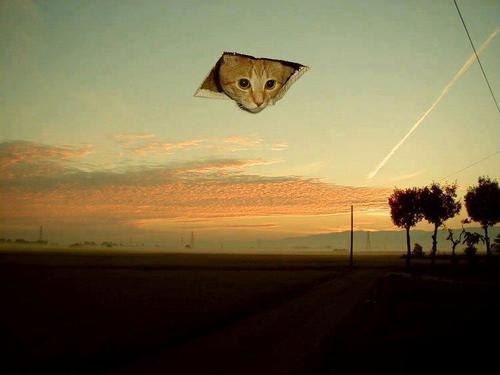
The photo shows a landscape at dawn or dusk: a wide field, a row of trees along a road, power lines, and a thin contrail in a pinkish-blue sky. In the upper part of the frame hangs a fragment resembling a folded sheet of paper or cardboard, out of which peeks the face of a ginger cat with big eyes. The levitation effect looks crude: the edge of the cutout is visible, and the lighting on the object doesn't match the lighting of the sky. It's exactly this implausibility that makes the picture convenient for an ironic caption.
The composition resembles many photomontages of the early internet, where a simple editor was used to cut an object out and paste it into someone else's landscape. The viewer immediately understands they're looking at a joke, not a documentary photograph, and it's exactly this obviousness that allowed the image to be used in all kinds of arguments.
Origin of the phrase
The expression "Checkmate, Atheists" appeared in English-language circles as an ironic formula for winning an argument about faith. In chess terminology, "checkmate" means the king's final defeat, and the people behind the phrase carry that metaphor over into a discussion where a believer supposedly beats an opponent who denies God's existence. The phrase quickly became a template for comments on forums and in chats, used as a reply to any argument in favor of divine intervention.
The Russian-language version, "Shakh i mat, ateisty" ("Checkmate, atheists"), became established as a direct translation and kept the same tone. The phrase sounds more like self-irony about excessive confidence in one's own arguments than like a serious statement. That's why it was used online by both sides: some to laugh at people who see omens in ordinary coincidences, others to respond to mockery aimed at them.
How the picture became a meme
The image with the cat is linked to 2007, when photomontages of flying objects and cat faces were actively circulating on imageboards and in themed communities. The exact author of the composition and its first publisher are not known, so specific dates and sources should be considered conjectural.
As it spread, the picture became detached from its original context. Users captioned it with the line about checkmate, and the image began to be perceived as a ready-made response in an argument. It was enough to drop the picture under an argument to show that the last word belonged to the person who sees a miracle where others see a coincidence.
Variants of use
In practice, the meme was applied in various ways. In some cases it was posted under a photo of a cloud that resembled a figure, or under news of a "miraculous" rescue, to ironically underscore the strained nature of the conclusion. In other cases it was used as a standalone symbol: a cat hovering over a field became a symbol of absurd certainty that requires no proof.
The picture was also often reworked. Users swapped the cat for other objects, changed the landscape, or added new captions, but kept the basic scheme: against the backdrop of an ordinary world, something inexplicable appears, and the arguer triumphs. Such reworkings show that the meme rested on the structure of the argument rather than on any specific image.
Cultural context
The phrase and the image belong to the tradition of internet debates about faith, where scientific arguments, random coincidences, and personal stories often become intertwined. The joke cuts both ways: it mocks attempts to substitute a flashy picture for proof, as well as the habit of arguing to win rather than to find the truth. That's why the meme remains neutral toward any particular faith and concerns the manner of arguing rather than the beliefs themselves.
Today the picture is perceived as a nostalgic sign of the early internet. It's recognized by the cat on the sheet of paper and the phrase about checkmate, and even without explanation it's clear that what's before us is the triumphant tone of an arguer who believes his point can no longer be refuted.