What can be seen in the frame
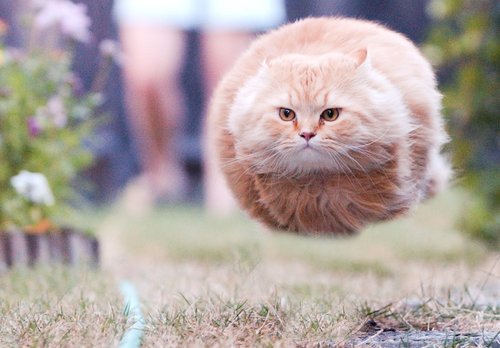
The photo looks like an ordinary garden picture with a soft background blur. At the center is a fluffy reddish-peach cat; its body is round, almost spherical, and its paws are tucked so that they are barely visible. Its face looks straight into the lens, its amber eyes wide open, whiskers stretched forward. The cat hangs in the air above the lawn.
The background makes it clear the shot was taken outdoors: on the left are flowers with pink blossoms and a wooden border, at the bottom dry grass, and behind the cat the legs of people in light clothing are blurred. It is these blurred legs in the background that create the sense of motion. The frame looks as if the object is flying through space rather than posing.
Origin: what is known and what is not
The picture is often called “Hover Cat.” Reportedly, the photo was taken in 2002 by Portland photographer Brian Hendrickson, who was lying on the ground shooting with a telephoto lens, and the cat's name was Cheddar. These details rest on a single source, so they should not be fully relied upon.
The dates and venues of the image's first publications are not established. As a meme, the picture spread online in the form of photo edits in which the cat was “launched” into various places and settings. Collections of cats in mid-jump include many similar photos, and linking this frame to a specific story should be done only with a caveat.
Why the cat looks like it is flying
The joke relies on the contrast between what is seen and what is expected. A cat is by nature flexible and elongated, but here it is round, like a ball. When such an object hangs above the grass without support, the eye completes the trajectory on its own: one wants to understand where it was thrown from and where it is going.
That is why the frame is convenient as a sign of urgency. If the image conveys the energy of motion, the caption can speak of haste, a sudden appearance or an abrupt exit. The best option is a short phrase explaining why everything happens so quickly, while the cat's calm face against this backdrop becomes the main part of the joke.
Examples of captions and their logic
Example 1: “The deadline is in five minutes, and the laptop isn't even open yet.” The cat's calm expression contrasts with the panic of the situation, and the viewer immediately understands the hero is already late.
Example 2: “Friday, nine in the evening, and the whole team has remembered we have a group chat.” The cat is cast as a sudden participant who appears without warning.
Example 3: “My brain, hearing the word Monday.” The reaction to the trigger looks exaggerated, but it is recognizable.
Example 4: “Me, when the food bag rustles in the kitchen.” Here the same scheme applies: an everyday sound instantly launches the hero, and the unperturbed face emphasizes that he supposedly did nothing.
All the examples work on one principle: the cat's impassive face creates a contrast with the sudden movement, and the caption explains where it is flying. Without a caption the frame remains just a lucky photo; with a caption it turns into a short story.
How to use this template
The frame suits short captions and photo edits where a sense of flight is needed. It is most convenient where the cat has a clear role: haste, a sudden appearance or leaving without warning. Then the picture works for the meaning of the caption, not just for recognizability.
For edits, a simple scheme works: take a background with a clear purpose, such as a door, a staircase or a table with food, and place the cat so that its trajectory leads to it. The caption can be kept minimal, because the composition already tells half the story.