What is visible in the photograph
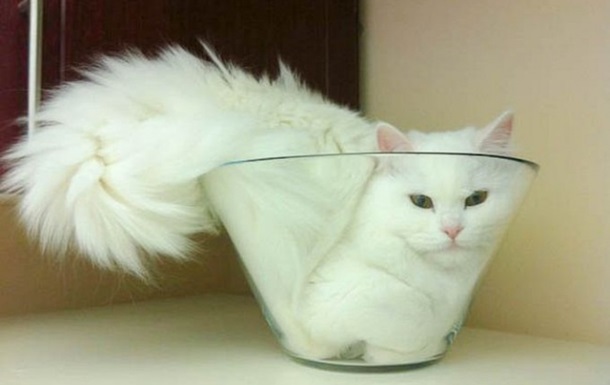
The frame shows a long-haired white cat with bluish-green eyes and a pink nose sitting in a wide glass bowl that widens toward the top and narrows toward the base. Above the rim can be seen the head with pointed ears and part of the back, while the fluffy tail is draped over the edge to the left, taking up noticeably more room than the dish itself.
The background is simple: a light wall on the right and a dark panel in the upper left corner, with the surface of a cupboard or shelf at the bottom. The cat looks straight into the camera and appears calm, with no fright and no attempt to get out. This detail matters, because the joke rests on the contrast between a cramped object and an unflappable animal.
Where the phrase came from
The wording “If it fits, I sits” is a play on the slogan “If it fits, it ships” (“fits in the box, we'll ship it”), which the US Postal Service used in its 2009 Christmas advertising. After that, the slogan began to appear in headlines for posts featuring cats sitting in cardboard boxes. The grammatically incorrect version “I sits” gave the phrase the character of a cat's “speech” and took hold.
The earliest known example of a macro with such a caption dates to October 10, 2011, and shows a cat in an egg carton. The next day a similar picture gathered more than 17 thousand upvotes on Reddit, and the format was then repeated hundreds of times. In 2012 a separate community for such photos appeared. The author of the very first caption is unknown, so one can speak only of the first known example, not of a proven origin.
What happened to the series in the Russian-speaking internet
In the Russian-speaking environment the series received the name “Pomestyus — usyadus” (“I'll fit — I'll sit”) and moved into animal communities. Under this name, photos are collected in which cats climb into boxes, sinks, cups, bags and vases. There is no single “first” shot here: the strength of the format is that any new frame of a cat in a tight spot can become part of the series without extra explanation.
The white cat in the glass bowl suits this kind of scene well: the transparent walls make visible how snugly she fits the shape of the vessel, and the tail hanging over the edge emphasizes the mismatch in size.
Why this joke works
The mechanics are simple. The viewer immediately sees that the object is too small and expects the animal not to fit or to be displeased. Instead, the cat sits confidently, and sometimes looks as though she chose the bowl herself. It is the gap between expectation and calm that creates the laugh.
For such a frame a caption is often not needed at all, because the whole story is visible at first glance. That is why the series easily expands: any photo in which an animal has squeezed into a tight place is read instantly, and the viewer completes the missing part themselves. A caption, however, adds a motive that explains the cat's choice.
Examples of captions and how they work
Below are four captions invented independently for this frame. Each one gives the cat a motive that explains her choice.
“We ordered a sofa. A bowl arrived, and it suits me.” The formula is a refusal to complain: the cat accepts an unsuitable object as a lawful replacement, and what is funny is exactly this calm acceptance.
“Please return me to the sender, I'm already packed.” A joke in an official tone: the cat speaks the language of delivery, as if she were a parcel. The contrast between the formal phrase and what is happening in the photo makes the caption short and recognizable.
“Questions about size are not for me, direct them to the dish.” This variant reverses the roles: the cramped one is not the animal but the object that fits poorly. The cat remains unflappable, and the viewer trusts her logic.
“Monday morning: the body is at work, the tail is still at home.” The caption connects the frame to an everyday situation and uses the tail sticking out past the bowl as a detail that could not otherwise be explained.
How to apply this template
A caption for such a frame is best kept short, because the main information is already visible. Long text breaks the rhythm, while a short phrase leaves the viewer room for their own guess.
Strong variants are built around the cat's motive rather than a description of her pose. If the caption says the cat is sitting in a bowl, the viewer sees that without any text. If the caption explains why the cat climbed in, the joke works twice.
The series is convenient for everyday situations where a person also chooses an uncomfortable place: a guest sofa, an armchair with a laptop, a cramped seat on a train. The main thing is that the parallel is clear without explanation.