What is visible in the image
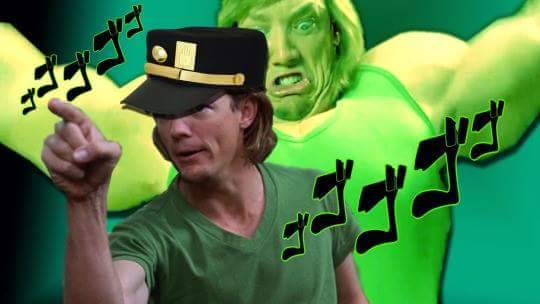
The image shows a man with long light hair in a green V-neck T-shirt. He wears a black cap with a gold emblem and thrusts his index finger forward. Behind him is a huge green figure with powerful arms and a tense snarl; the background is in dark green tones. Along the edges are the Japanese characters “ゴゴゴ,” which manga uses to convey mounting pressure.
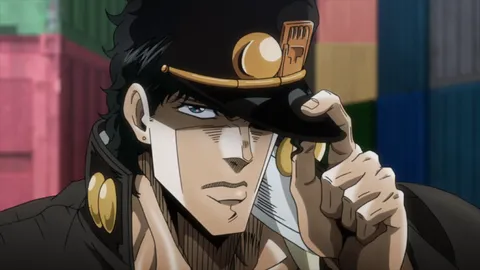
The cap and the sound effects reference the JoJo anime and manga, and the pose resembles the signature pointing gesture. This is an observation about the image's style: a caption naming the source of the edit is absent from the picture, so the discussion concerns the meme variant as a whole.
The 2011 film and the first scene
The series is usually traced back to the feature-length cartoon “Scooby-Doo! Legend of the Phantosaur” from 2011. According to descriptions, in one scene Shaggy, under hypnosis, suddenly becomes a strong fighter and takes down a gang of bikers at a roadside diner.
The scene is meant to be comic and childlike, not epic. That very gap became the joke's main resource: viewers are used to a Shaggy who is scared and runs away, so the sudden power looks absurd.
Ultra Instinct and the power scale
The meme's wide spread was prompted by comparing Shaggy's fight to the “Ultra Instinct” state from the anime “Dragon Ball Super.” Reportedly, a YouTube user cut the scene to music from that anime, after which the pictures began circulating as a power scale: each next level showed the hero even more powerful.
Later a petition appeared demanding that Shaggy be added to Mortal Kombat 11. It was reported that the signatures reached hundreds of thousands, though different publications cite different figures. The character never made it into the game, but the meme's continuation shows how it went beyond pictures.
Caption examples
Example 1: “The office ran out of coffee. I don't go for coffee; coffee finds its way to me on its own, because I'm Shaggy.” An everyday trifle turns into a demonstration of power, and the absurd reversal of cause and effect works as a joke about omnipotence.
Example 2: “Asked to help with a move. Showed up with one box, and the sofa carried itself away.” The caption keeps the contrast between the modest request and the scale of the result.
Example 3: “In the ice cream line I just looked, and the line parted.” The power shows up without effort, as it should in this series.
All the captions rest on one device: a modest occasion first sets up the expectation of an ordinary situation, and then gives way to cosmic scale.
Why the joke endures
In children's cartoons Shaggy is a cowardly, perpetually hungry companion. So the idea of an all-powerful being looks absurd, and it is this absurdity that makes the meme recognizable. The genre rule is simple: the hero has divine power, and the humor comes from the contrast with his usual image.
The meme concerns the character, not real people, so the captions are safe as long as they stay within the game of playing with the image. The power scale can be continued indefinitely, and each new level still works.