What the image shows
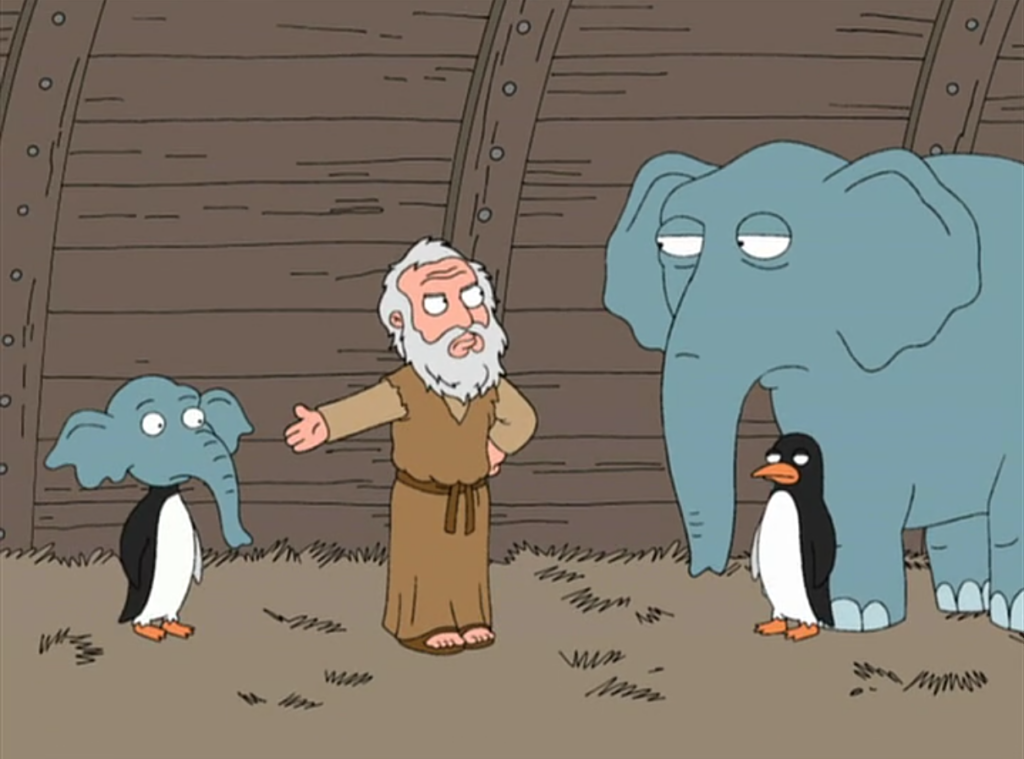
The picture shows a scene inside a wooden ark hull: dark boards, metal rivets and curved beams. In the center stands a gray-bearded man in a brown cloak with a rope belt, wearing sandals. He has stretched his right arm to the left, as if presenting something to the viewer, and his head is tilted slightly to the side. He looks tired.
On the left is a small character: the head and trunk of an elephant in gray-blue, with the body of a penguin with a black back, white chest and orange feet. On the right is a large blue elephant, and beside its leg stands an ordinary black-and-white penguin. All the figures are drawn in the flat two-dimensional style typical of the series.
There is no text in the picture. The format relies on the scene itself: the viewer sees two “parents” and an offspring that mixes the traits of both, and this reads at a glance.
Where the scene comes from
The scene is taken from Family Guy, the American animated series created by Seth MacFarlane. In this gag Noah appears as a man who has to deal with the consequences of animals “mating” on board the ark. The exact episode and air date are not given here, because they could not be reliably confirmed.
It is worth separating the air date of the episode from the date the meme appeared. The earliest known use of the frame as a template for captions is dated to the late 2010s, but this is an approximate estimate, not a documented first publication. The author of the captioning device cannot be identified. It is only known that the scene is widely used in meme generators, and the large number of variants shows how easily it transfers to new topics.
What this meme means
The meaning is simple: two concepts that do not usually go together are combined into one result, and the result is a failure. When the viewer sees the frame, they immediately connect the parents and the offspring, and Noah seems to speak on behalf of everyone who is watching the fruits of someone else's experiment. The humor rests on the contrast between the character's tired face and the absurdity of the situation.
The mechanism differs from a plain joke about absurdity. Structure matters here: first two things are named, then the hybrid is shown, and the reaction is clear in advance. That is why such captions work without explanation, provided the pair is chosen precisely and is easy to recognize.
Caption examples
Example 1: “Monday and coffee: the result is a Tuesday that nobody likes.” Two familiar things are combined, and the offspring has inherited the worst from both.
Example 2: “A report and Friday: and here is the report you had to redo on Sunday evening.” The second part of the caption brings the absurdity down to an everyday situation, and the frame works as a short illustration.
Example 3: “Instructions and a furniture box: the result is a wardrobe with one extra bolt and without two that you need.” The joke depends on precise detail: the reader immediately sees the contradiction and recognizes it.
These examples work the same way: each caption names two objects, presents the hybrid as the outcome, and relies on Noah's reaction, which the viewer completes in their own head. The more specific the pair, the clearer the result and the stronger the effect.
How to use this frame
The frame suits comments about strange combinations in household items, food or work projects. It is better to show one pair of objects rather than three: the frame already has two animals, and extra elements disrupt perception.
The meme mocks the result of a combination, not a person. For that reason it should not be used against specific people, their appearance or personal circumstances. That keeps the joke harmless and lets the picture keep working.