What is shown
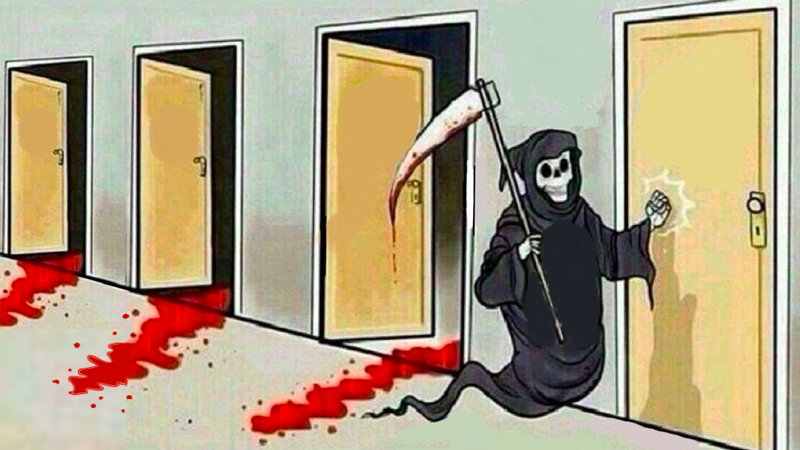
Death is drawn in a black hooded robe, and instead of a face there is a skull. The lower part of the figure smoothly turns into a trailing fold of cloth, so it seems to glide above the floor. With a clenched fist in its right hand, it knocks on the closed light door on the right, and short strokes of impact are drawn around the fist. In the other hand is a long scythe, its blade stained red.
A row of doors stretches along the left. The door nearest to Death is ajar, with a dark opening behind it; the rest are also flung open or standing open. Red streaks and splashes run across the floor from the thresholds, as if Death has already walked down this corridor. There are no inscriptions in the picture, so the meaning rests only on the sequence of doors.
What is known about its origin
The author of the drawing and the first publication have not been reliably established. The picture has lived online for a long time without captions, so it is easy to adapt to any plot. Earlier, names of countries and other political captions were added to it, but it has not been possible to reliably confirm a specific original version.
Because of this, it is safer to speak of a type of joke rather than one “correct” meaning. The template exists as a pure scheme: a corridor, a row of doors, and a figure that moves along them.
Why the row of doors is funny
The joke rests on repetition. The viewer sees several open doors and blood and expects the next one to open too. When Death knocks on the last, closed door, the expectation is fulfilled, and it becomes clear that the next item is already on the list.
The tone is dry: Death does not hurry or get angry; it simply does its job. Because of this calm, the picture sounds ironic rather than frightening. The blood serves not as a scare but as a tally: it shows that each door has already cost something.
Caption examples
The examples are made up for this frame and do not refer to real people.
“Monday ruined the plans, Tuesday ruined the plans, Wednesday ruined the plans. Friday is already knocking.” The triple repetition of the same action sets the rhythm, and the next element continues it.
“Coffee, sleep, salary, patience — each item has already had its own door slammed shut. Only the last one is left, and that is the one being knocked on.” The list ends with a knock on the final, still closed door: its turn has come, and the figure's calm in the picture makes the ending funny rather than frightening.
“Finished reading the manual, installed the update, fixed the router. Now it's the phone's turn.” The template also works on everyday scenarios: each door is a small thing, and the last one becomes the most noticeable outcome.
How to use the template
The template suits a story of three or four steps, where each step is a separate door. The shorter the items, the stronger the effect of repetition, so do not stretch each door into a separate sentence.
The caption should set up the last door: that is what makes the joke. There is no need to explain everything in the text; the corridor and the blood show by themselves what happened earlier. If the first items already sound heavy, it is better to make the last one unexpectedly mundane: the contrast between the scene and a trifle is stronger than yet another grim detail. Do not use the frame to mock real tragedies or the deaths of specific people: the joke works on everyday and abstract occasions.