A family argument that got other people’s topics
The scene aired on April 9, 2009, in the episode NHL Bike / B2 Bomber Bike, which opened the sixth season of American Chopper. The reality show followed the work at Orange County Choppers, where Paul Teutul Sr. built motorcycles together with his son Paul Jr. The conflict arose over the younger man’s morning lateness and escalated into a sharp argument; by the end of the episode, the father fires his son from the workshop.
The well-known re-captions appeared at the end of 2011, and in 2012 a comic version spread featuring an emphatically polite conversation. Footage of angry people was accompanied by calm requests and expressions of gratitude. In March 2018 the format got a new wave: long collages were used for arguments about artworks, tastes, and household rules. The television event, the early remakes, and the later spread are separated by several years, although in memes they look like one continuous scene.
The finger points beyond the edge of the frame
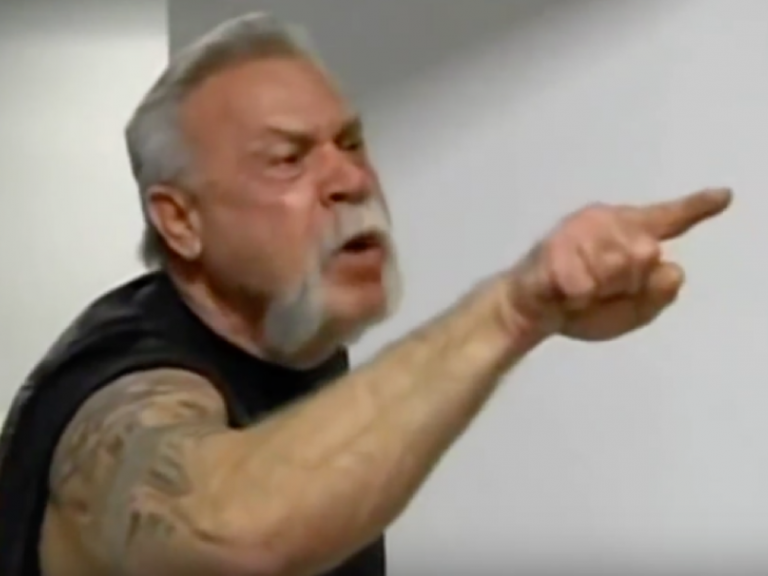
This picture contains only Paul Sr. He has gray hair, a big mustache, and an open mouth. A black tank top leaves a shoulder tattoo visible; his arm is stretched to the right, the index finger pointing at a person outside the frame. Behind him is a light wall. The son, a chair, captions, and other panels are absent here.
The frame conveys one side of the conversation, so a new caption can be a complete remark: a demand, an objection, or an attempt to put a period on the discussion. The finger signals direction even when the addressee is not shown. In the full collage, the son’s replies return the argument to the beginning or develop it; the single image holds only the moment when the speaker is sure his point must finally end the discussion.
A loud form and a tiny object of dispute
The re-captioning keeps the power of the gestures but changes their basis. The viewer sees a tense conflict and reads about an argument over the order in which to wash the dishes. The mismatch gives even an ordinary argument the weight of a final speech at an important meeting. The opposite move works well too: extremely polite words accompanied by the pose of someone who clearly has no intention of waiting calmly for an answer.
The multi-panel version is also valuable because it leaves room for several arguments. Participants can take turns clarifying definitions, finding exceptions, and accusing each other of inconsistency. There is no required winner: the dispute can loop back to the first remark. That is why the template suits disagreements where both sides are right in their own way, but the emotional heat has long exceeded the importance of the question. A single frame of the elder compresses this structure into one most insistent objection.
Conversations that got too much energy
In an invented sketch, the father demands that the extra tabs be closed, and the son explains that each one will still be needed. After the question “When?” comes the answer “When I remember why I opened it.” In the full collage the lines can alternate; a single frame suits the final objection that the browser is already busy storing forgotten intentions.
Another invented version uses the contrast between text and pose: an angry man with a finger is captioned “Of course take the last cookie, I don’t mind at all.” The words depict politeness, while the gesture reveals excessive involvement in observing it. In a third example, two voices of the same person argue over whether a trip to pick up a package counts as a walk. One cites the step count; the other reminds that the whole route was walked for a new keyboard. The scene of a family workshop turns into an inner argument about one’s own small victory, and its recognizable energy gives both arguments equal weight.