What is visible in the photo
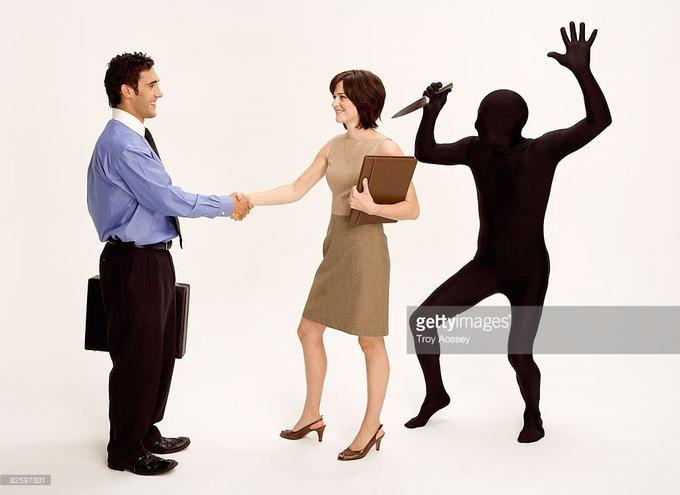
The shot was taken against a light studio background. On the left stands a man in a light blue shirt and dark tie, with a briefcase beside him. He is smiling and extending his hand. Opposite him is a woman in a light top and a sand-colored skirt, with a brown folder under her arm. She is also smiling and returning the handshake.
On the right, slightly behind the woman, is a figure in a black form-fitting suit that covers the whole body and head. One arm is raised, and a knife is clutched in the other, so the figure seems ready to strike. Because of the black color it looks like a shadow rather than a person. In the lower right corner are a Getty Images watermark, the number 82597831, and the photographer's name, Troy Aossey.
The frame is clearly staged: every character is positioned so that both the handshake and the threat are visible. The meme rests precisely on the contrast between the smiles and the shadow, not on any real story.
Where the photo came from
The photograph exists as a stock image, that is, one intended for sale of usage licenses. The photographer named in the watermark is Troy Aossey. The shooting date is not stated, so the exact time the frame was made is not established.
Its wide spread is linked to August 24, 2017, when the photo was posted on Twitter on a page that shares strange stock photos. Within a few months the post gathered more than 875 retweets and about 2,200 likes. The stock picture became a meme not on its own, but after users reinterpreted it.
The first captions and spread
The earliest known caption dates to October 25, 2017. In it the man is labeled “me,” the woman “an opportunity for happiness,” and the shadow “severe depression.” This version is most often considered the basis of the format: the shadow becomes an internal threat rather than an external one.
In January 2018 the picture was posted on Tumblr, where it gathered more than 330 notes in six days. About five days later a version appeared on Reddit in the r/dankmemes community, where the shadow was named “every meme of 2018.” The next day r/MemeEconomy featured a variant captioned “feature creep,” meaning the bloating of features. In this way the format moved from personal struggles to jokes about the internet and work.
The mechanics of the joke
The viewer first sees a calm business scene and a polite smile, and only then notices the shadow behind the back. The shadow works as a truthful caption: it shows that the real problem is not in the conversation but nearby. In memes the shadow can become anything: a deadline, a message thread, a to-do list, or the flow of identical pictures itself.
The template has no single meaning. In the early version it refers to a person's inner state; in later ones, to a general sense of trouble that accompanies pleasant things. That is why the same photo works for self-irony, for jokes about work, and for conversations about habits.
Examples of captions
Example 1: “Me and my weekend plans” — “Shadow: Monday at 9:00.” The smile matches the plan, and the shadow shows when it will end. The joke works because time itself becomes the threat.
Example 2: “New client and his edits” — “Shadow: edits sent for the fifth time.” A polite deal turns out to be unpleasant, even though on the surface everything looks peaceful.
Example 3: “Agreed on the call” — “Shadow: the email that will be written after the call.” After the handshake the viewer expects a calm conversation, and the shadow destroys that expectation with a single word.
Example 4: “Me when I open the fridge” — “Shadow: what I bought myself yesterday.” A variant for domestic irony, where the frightening figure turns out to be one's own habit.
How to work with this template
The caption works better when the shadow personifies a situation rather than a specific person. If the caption points to a real person, the joke stops being about the situation and becomes about the person. It is better to choose topics from everyday life: deadlines, household trifles, habits.
The frame works best when the text is short. Three captions are usually enough: the first sets up who is smiling, the second names the shadow, the third reveals the twist. If there are more captions, the effect blurs and the surprise disappears.