From a strike to an invented demand
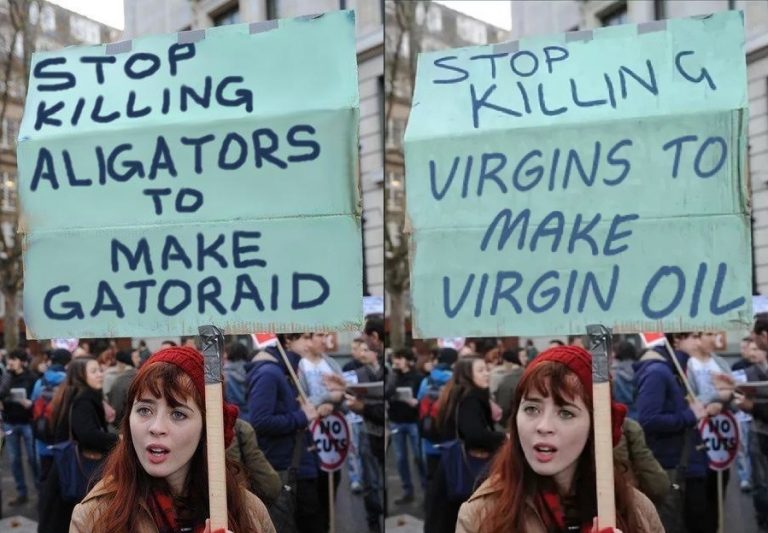
The basis is a photo from a London strike of public sector workers in 2011. In Stefan Rousseau's picture a woman held a sign with a rather restrained message of her discontent. There was no demand to stop producing drinks from animals there: it was added during photo processing, preserving the person, the crowd, and the cardboard sign itself.
The alligator version gained a noticeable online trace in March 2018: on the fifth the picture was posted on Imgur by user gutkhababa. This is a known early posting, but it does not establish the author of the remake. By June the joke had grown into a series: instead of a single specific drink, other products were substituted whose names could be deliberately misunderstood. Thus the photo of an old strike turned into a universal scene of an absurd picket.
Two captions on one poster
This picture places side by side two processings of the same frame. A woman in a red hat and light coat stands at the bottom, and above her rises a turquoise poster on a wooden pole. The left half says: stop killing alligators for Gatorade; the right half: virgins for virgin oil. The person's position and background repeat, so the collage itself demonstrates the text substitution.
Uneven capital letters and spelling mistakes make the slogan look like a hastily made real poster. The crowd behind lends it the appearance of a public statement. However, the comic voice belongs to the caption invented for the photomontage: the expression on the striking woman's face says nothing about her attitude toward drinks or oil.
The name is mistaken for a recipe
In English, “gator” is a shortened name for an alligator. So in the joke Gatorade turns into a drink for which these animals are supposedly harvested. The word “virgin” in the name of the oil denotes its quality and method of processing, but the meme deliberately transfers it onto people. The error works the same way in both cases: a familiar word is taken as a direct indication of the raw material.
After this substitution everything else looks consistent. If the product is supposedly made from creatures, an imaginary factory arises, along with its victims and a demand to stop production. The reader recognizes the normal logic of protest before noticing the impossible premise. The phrase “stop killing” strengthens the contrast between solemn alarm and a trivial sound-alike; without the product name it would be an ordinary slogan, and without the poster, a short pun.
How the wordplay continues
New variants can be imagined on familiar Russian words. A poster reading “Stop catching mice for computer mice” would depict a person who took the device's name literally. The version “Stop mining clouds for cloud storage” transfers the same mistake to a digital service: invisible servers turn into an enterprise for harvesting celestial material.
One more invented version is “Stop dismantling stars for star-shaped pasta.” Here the shape of the pasta is already passed off as its origin. In all three cases the reader needs only two linked words; a detailed story about a factory would only weigh the joke down. The most recognizable feature of this format is the confident demand, behind which hides a mistake in the literal understanding of language.