Soil, a queen, and an invented legend
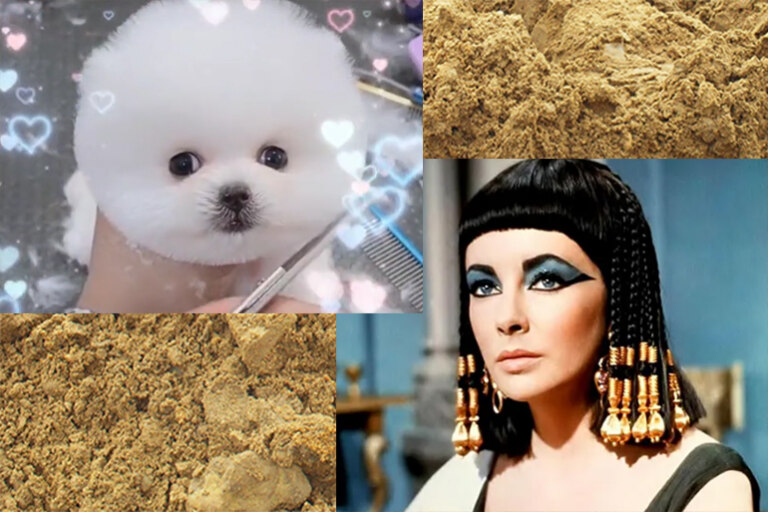
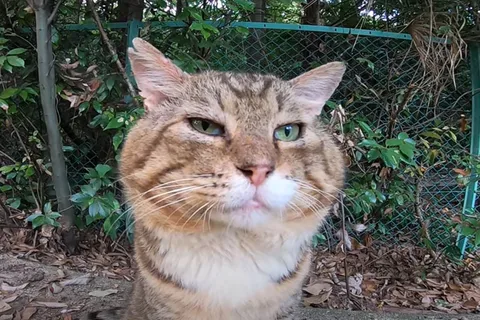
The picture joins a photo of a fluffy animal with the image of Cleopatra and other visual fragments. This juxtaposition sets the tone: this is not an illustration of a historical episode but an intentionally absurd collage. In reality, loam (suglinok) is a type of soil with a significant share of clay particles; Cleopatra VII was a ruler of Hellenistic Egypt. There is no known historical connection between these facts, and the meme doesn't require you to find one.
The format grew from absurd short videos and posts where authors invented pseudo-lore about "suglinki" (loams), accompanied by a synthetic voice and random images. What matters is not the exact sequence of all publications but the technique: an ordinary word is presented as the name of an ancient people, secret clan, or epic hero. The more seriously the narrator explains the made-up conflict, the stronger the comic effect of its obvious nonsense.
Don't try to build a consistent mythology
The meme intentionally offers no stable canon. In one video the loams may seem like Cleopatra's opponents, in another separate creatures, relatives, or participants in an absurd adventure. The collage with an animal also doesn't confirm which character it represents. If an author's adaptation assigns the picture a specific biography, this should be understood as new fiction, not an established part of the shared plot.
A comic violation of causality works here. An ordinary geological category is announced as a character in historical drama, and a royal name adds weight. You can recognize familiar motifs of ancient legends, but the meme is not an educational retelling of Egyptian history or mockery of real culture. It replaces cause-and-effect logic with an endless pile-up of confidently spoken but completely unconnected details.
How to compose your own episode
For example: "The loams came to Cleopatra asking for political asylum, but she gave them a slip for a drainage consultation." Here a mundane service is unexpectedly built into pseudo-epic. Another option: "Cleopatra asked who left tracks in the hallway, and the loams called an emergency council." The caption doesn't have to explain why soil became a participant in events: the lack of explanation supports the genre.
You could also adapt the template to work routine: "The loams teamed up with the purchasing department to return one lost stapler." Or to a study chat: "Cleopatra announced an exam, and the loams asked to move it to a slightly later epoch." These examples work as continuations of the absurd universe, not as descriptions of the picture. It is better to keep a short rhythm: a name, a solemn action, a suddenly mundane obstacle.
Appropriate tone and factual care
Such a meme should be used where the audience is familiar with deliberately meaningless internet humor. It works for unexpected transitions between topics, pseudo-historical explanations of small things, or a series of short phrases where each next fact becomes more absurd. If context is unclear, a single caption suffices: a long explanation of the plot seems to promise a logical system and weakens the joke.
It's useful to separate fiction from real history. Don't attribute invented words to Cleopatra as genuine quotes, don't call the loams a historical people, and don't pass off an animal in the collage as an accurate mythological symbol. Describing the real meaning of a word helps understand the contrast but doesn't serve as proof of the meme's origin. Its main point is not a hidden secret but a game with pseudo-serious delivery of an obviously impossible story.