Origin of the filter
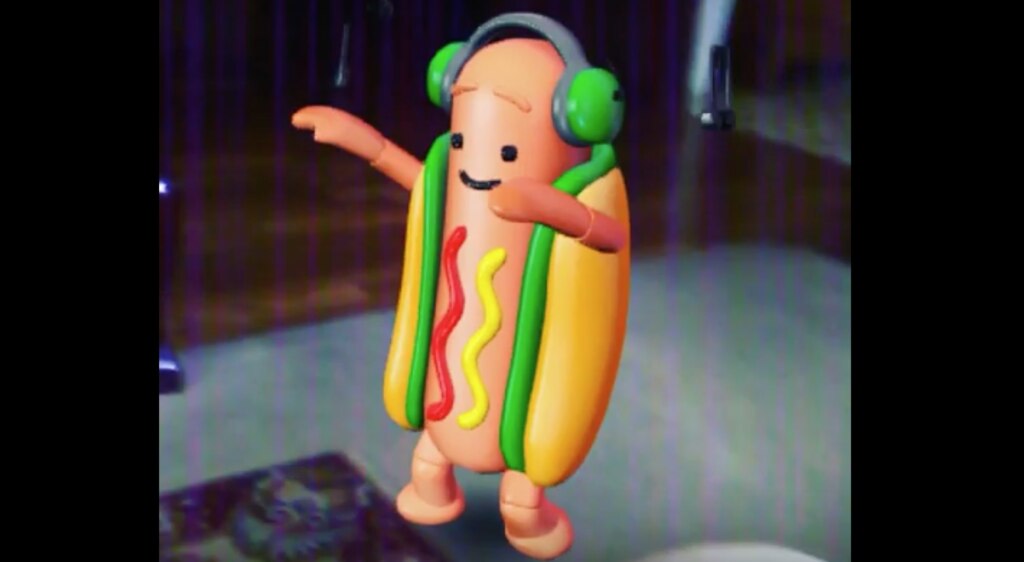
In the mid-2010s, Snapchat was actively developing augmented-reality lenses — effects overlaid on the phone camera's image that react to movement. One of these effects was the dancing hot dog: a three-dimensional character with a smile on its sausage-shaped body, green headphones, and streaks of mustard and ketchup, which appears on screen and starts moving to music.
The exact date the lens appeared and its creators have not been established. The filter's wide fame is commonly linked to 2017, when Snapchat lenses became the app's main tool for viral promotion and users massively recorded videos with unusual characters.
How the filter became a meme
The shift from filter to meme happened simply. Users recorded short videos of themselves dancing next to the hot dog, or sent each other screenshots. Videos spread beyond Snapchat into other networks, where the short looping dance worked well even without sound or captions. The character quickly made its way into roundups of the most notable viral filters and became a recognizable image among teenagers and young users.
An important feature was the readability of its silhouette. The headphones, the raised arm, and the distinctive pose made the hot dog recognizable even in a small preview. This allowed it to be used as a reaction in chats, a sign of approval, or an ironic comment on a situation where it's time to simply start dancing.
Variants and use
Remixes appeared online: the hot dog was placed into famous scenes, given captions, inserted into videos with other dances, or linked to specific music tracks. Most often the meme was used as a visual joke about sudden joy, readiness to have fun, or one's own dancing failures. In these cases the hot dog played the role of a naive character unashamed to dance in the middle of an ordinary day.
The format combined well with short text. One frame and a caption were enough to convey the thought "I'm in a good mood today" or "it's Friday and I'm ready." That's why the character held steady in roundups of reactions and stickers, even after the filter itself stopped being a novelty.
Cultural context
The dancing hot dog fits well into the wave of short dance videos later popularized by Vine, Musical.ly, and TikTok. Snapchat's lenses created a sense of personal involvement: the user didn't just watch a dance but ended up in the frame together with the character. This format reflected the platform's general logic — quick visual inserts that are easy to repeat and send to a friend.
The meme is also telling as an example of marketing mechanics. Filters drew attention to the app and boosted engagement, while users turned them into their own content for free. In this sense, the hot dog became not only a joke but also a small tool for promoting the platform, one that worked through people's desire to share funny finds.
Legacy
Years later, the image remains recognizable, and it continues to be recalled in nostalgic roundups about the internet of the late 2010s. For those who remember Snapchat's early years, the hot dog is tied to the feeling of a simple and fun era for the app, when lenses still seemed new and almost playful.
The character itself carries no complicated subtext. Its humor is built on naive energy, absurdity, and the contrast between the sausage's earnest expression and its energetic dancing. That's exactly why the meme is easily understood by different audiences even without knowing the context, and the image itself endures as an example of how a short filter can become part of shared internet culture.