Clarkson's choice on a road trip
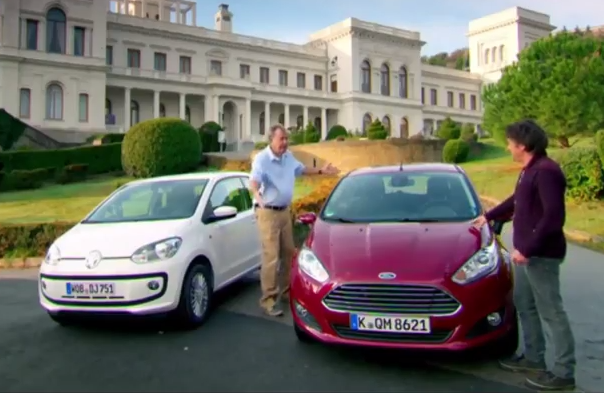
The line was spoken in the third episode of season twenty-one of Top Gear, which aired in February 2014. The presenters travel through Ukraine in small cars. Richard Hammond drives a Ford Fiesta, and Jeremy Clarkson drives a Volkswagen Up! Clarkson readily praises his colleague's car, and Hammond points out the contradiction: then why did he bring a different one? The answer shifts the conversation from a technical comparison to a matter of attachment. Clarkson then even compares his choice to his love for his own terrier, which has its share of flaws.
Which car gets which role
In the image, the white Volkswagen stands on the left and the red Ford on the right. Clarkson, in a light blue shirt, stands between them gesturing, and Hammond, in dark clothing, stands by the red car. Behind them are a light-colored building and a neatly trimmed garden. It is a single shared shot with no captions. In common remakes, the praise goes to the Fiesta on the right, and the personal choice is labeled as the Up! on the left. The color of the car is not an evaluation in itself: the meaning of the positions is set by the presenters' conversation.
Other versions split the scene into two panels and add the words of the line. The comparison then reads in sequence: first the viewer sees a strong argument for one thing, then learns of an unexpected preference. The shared shot works differently, since both options stay in view at the same time, and the captions turn the cars into two symbolic objects. A conversation about cars can become a debate about movies, food, entertainment, or an old favorite thing.
The April wave four years later
The early well-known version with text labels was posted by Sh1ckDits to the Reddit community r/Animemes on April 27, 2018. It compared Steins;Gate and Re:Zero. On the same day, other comparisons and discussions of the format appeared in MemeEconomy, and then neighboring communities picked it up. This is how a line from a car show became a universal language of preference. The date of this wave refers to the captioned images, while the television material existed long before them. The earliest surviving post does not establish that no one had joked with this phrase before.
Acknowledging merits and still choosing the other
An important feature of the meme is that the first half remains genuine praise. The author is not obliged to expose the good option or prove the superiority of the favorite. The comedy arises when objectively sounding arguments do not determine the outcome. In one case it is a tender attachment to an old habit, in another it is the self-irony of a person who knows about the more sensible decision. The word “but” joins two different scales: the assessment of quality and personal enjoyment. It is their divergence that gives the scene more nuance than a simple approval placed next to a refusal.
The favorite mug and the map without conveniences
In an invented comparison, the red car is labeled “a new mug that is easy to wash” and the white one “an old mug with a summer camp design.” The preference does not require treating the new dishware as bad: the second item holds the owner's history. Another invented pair is a modern game map with clear navigation and an old map on which friends for years knew every strange staircase. Convenience loses to a familiar shared memory.
A more mocking variant contrasts a neat shopping list with the urge to go to the store relying on memory. Here, affection for freedom ends with forgotten salt, so the acknowledgment of the list's advantages takes on an extra layer of irony. The three examples use one line but express different attitudes: attachment, nostalgia, and deliberate illogic. The viewer smiles at the moment they understand a reason for the choice that does not match the original praise.