Format and visual basis
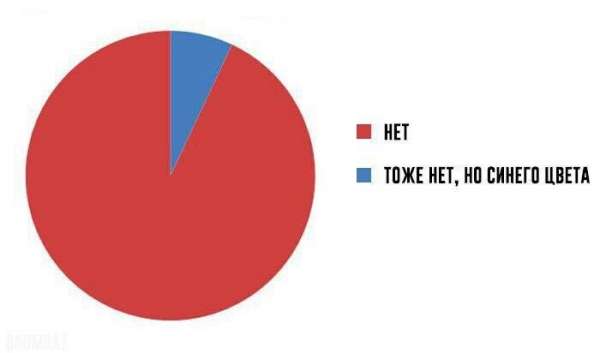
A pie chart is normally a serious tool: it shows shares, percentages, and helps compare categories. In this meme it is turned into a parody of a poll, where the result is presented as statistics. The "no" sector takes up almost the whole circle, while a tiny slice is given over to a second option that, in meaning, is identical to the first.
The image looks like a clipping from a report or a presentation, and this official appearance heightens the comic effect. The viewer expects to see different data, but instead gets the same idea delivered with businesslike seriousness.
Origin
The exact author and first publication of the meme are not known. The meme dates to 2017, when parody images of office charts and corporate presentations were actively spreading online.
In the version shown in the image, the caption specifies "blue," whereas the post's description says "a different color." This is the same joke: the principle doesn't depend on the specific shade, and the color merely serves to visually separate the second sector from the first.
The logic of the joke
The key to the humor lies in the expectation of a second option. Viewers are used to charts showing different categories, and they start looking for meaning in each sector. When the second sector repeats the meaning of the first, it produces an effect of unexpected confirmation. The irony is that the refusal seems to be reinforced: no, and also no, just in a different color.
This construction is handy for signaling a categorical refusal in correspondence, or for joking about bureaucratic answers that formally offer a choice but in substance leave none.
Variants and spread
The format was easy to transfer to other subjects: instead of "no" there could be "yes," "I don't know," or the name of a specific situation, and the colored sector could be swapped for any other shade. The meme worked well when forwarded, because it was understandable without captions and took up little space on the screen.
Users created their own versions, changing the labels and colors, and in doing so kept the joke active. Sometimes the caption was made as serious as possible, for instance in the form of a headline naming the poll, and this heightened the contrast between the official form and the absurd content.
Significance in internet culture
The meme belongs to a group of absurd visual jokes that parody the language of data and statistics. Such images show that internet humor often relies on recognizable forms: charts, tables, interfaces, and official forms. Also No, But a Different Color remains an example of a simple construction in which one idea is presented in different guises.
Thanks to this simplicity, the meme is understandable to different audiences and requires no knowledge of a specific context. It's enough to see the circle and two captions to get the joke, and that's exactly why the format keeps turning up in discussions and comments.