The film and its plot
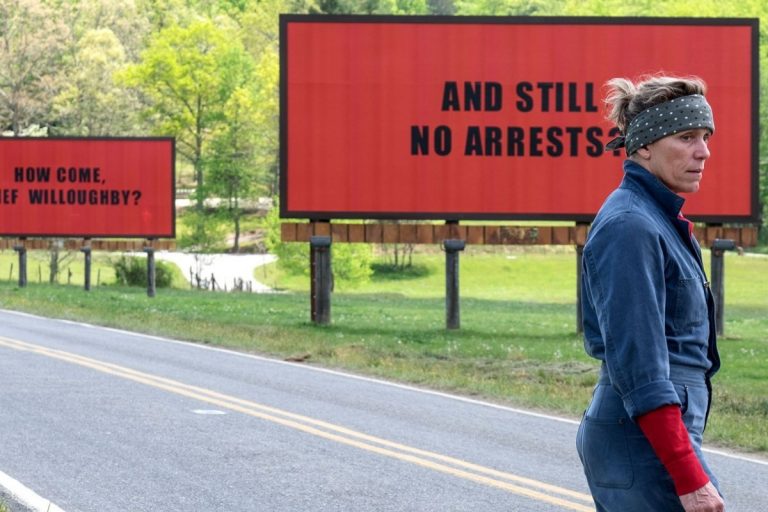
*Three Billboards Outside Ebbing, Missouri* is a 2017 drama directed by Martin McDonagh. Frances McDormand plays the lead, Mildred Hayes. After her daughter is murdered and the police never solve the case, she rents three billboards on the edge of town and posts blunt questions for Sheriff Bill Willoughby.
The film won several Oscars at the 2018 ceremony, including Best Actress and Best Supporting Actor. The billboard scene became the picture’s signature image and the source of the internet format.
Spreading online
After the premiere, and especially after the awards ceremony, the frame with the three red billboards spread online as a template. Users removed the original text about Sheriff Willoughby and wrote their own lines, keeping the composition: big black capital letters on a red background, split across three consecutive billboards.
The format is easy to use because it requires no complicated editing. You just replace the text on a ready-made image template built from a film still, which is why remakes appeared almost simultaneously in different corners of the internet.
Typical captions
Most remakes keep the logic of an escalating complaint: the first billboard sets the topic, the second raises the stakes, and the third delivers a direct jab.
Examples circulating online include: “Where’s the promised update?” / “Seriously?” / “We’re still waiting.” Or a household version: “Who ate the last slice of cake” / “And didn’t even confess” / “And you promised to go on a diet.” This three-part structure makes it easy to adapt the meme to work, home, or news situations.
Versions with two billboards instead of three also exist. In those, the second line becomes the final punchline rather than an intermediate escalation. But authors more often keep the triple structure, since it sticks closer to the original frame and viewers recognize it at a glance.
Why the format works
The format’s strength lies in the contrast between the official look of a billboard and a personal, emotional statement. Big type and a plain red background make any line sound like a public accusation, even when the subject is something trivial.
Frances McDormand’s presence in the frame, with her recognizable stern expression, adds to the effect. Viewers catch the film reference almost instantly, even before reading the text on the billboards.
It also matters that the scene in the film is already a visual metaphor for injustice and persistence. By transferring that metaphor to an everyday situation, remake authors ironically inflate how serious the matter is, and it’s this mismatch in scale that gets the laugh.
Unclear origins
The first remake that swapped in new text is not documented. The template took shape gradually as the frame spread after the premiere and the awards.
So it is more accurate to describe the format as collective, arising from a widely shared still, rather than as the work of a single author at a single moment. Which platform, whether Twitter, Reddit, or local groups, became the main point of distribution also cannot be determined definitively from open sources.