What is shown
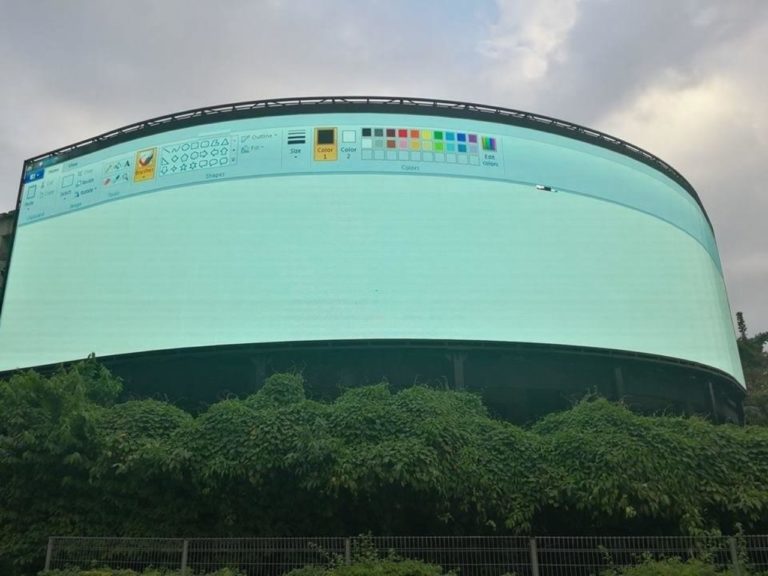
The photo shows a curved advertising screen mounted above a green hedge. The surface of the screen is a pale turquoise, and across the top runs a toolbar of a familiar kind: rows of tool buttons, a color palette, and a “Size” block. The labels “Color 1” and “Color 2” are in English, which confirms that the software interface is indeed Paint. The interface elements are stretched across the full width of the structure, so even the small details can be read from the street.
The shot is taken from below, at ground level, through a railing. The sky is gray and overcast. The scale of the structure is clear without a caption: this is not a monitor or a TV, but a large architectural installation that passers-by can see.
Origin of the photo
The photo is placed in Malaysia, and it is claimed that unknown hackers opened Paint. This story is unconfirmed: the source of the photo, the date, the exact location, and the company operating the screen are not known. It is also unclear whether the hack was real or the photo was staged from the start.
It is possible that the program window was left open for a technical reason, with no outside involvement. This is a guess that is not backed by any sources. Until a confirmed version appears, the photo should correctly be treated as an image of unestablished origin.
Why it is funny
The main joke is built on the contrast between scale and content. A huge surface that is expensive and draws thousands of glances ends up given over to the simplest graphics editor, which has nothing but a white field and a set of tools. For anyone who learned to draw in Paint, the sight is nostalgic.
The program has become a symbol of simple things, and its appearance on a giant screen is a reminder that technology is not always used in impressive ways. That is why the photo is read as an ironic comment rather than as an advertising story.
User captions
Internet users immediately began adding their own captions and drawings to the pictures. The format invites everyone to leave their own mark on the screen, so the captions are usually short and self-deprecating. Examples in this spirit include “Not a single pixel, but full control” and “It wasn’t just one Vasya here — it was a whole crew.”
Such replies turn the empty canvas into a shared space for jokes. The meme rests precisely on the possibility of adding your own version to the picture, and each new caption adds a small touch to the story.
Over time, the pattern itself became clear to anyone who had seen such photos. First comes surprise, then the urge to add your own line, and in the end the picture turns into a small collective album. That is why the meme stays appealing even without a confirmed hacking story: the scene alone is enough for the viewer to join in.
Place among memes about advertising screens
Hacked billboards form a separate genre of street humor. An encyclopedia article on billboard hacking describes cases in Paris, Sydney, London, Hong Kong, San Francisco, Belgrade and Atlanta, where the screens were used to display other people's messages. Against this background, the description of the Paint meme looks gentle: there are no threats in the text and no ads for competitors, only an empty canvas.
It is this gentleness that makes the photo a convenient template. It is easy to carry over to any situation where a large resource has been put to an unexpected use, which is why the topic keeps coming back in conversations about advertising and internet humor.