Four panels and two characters
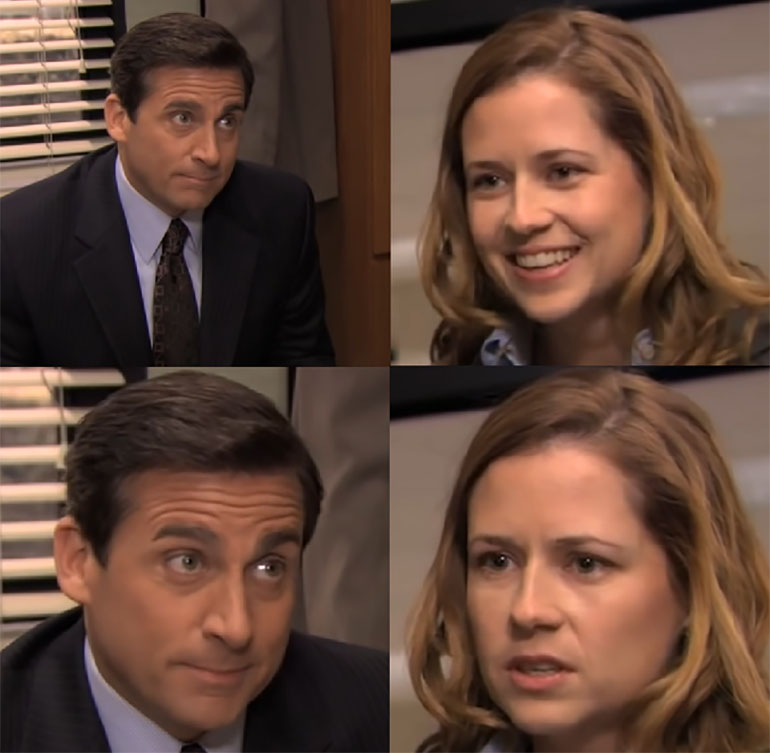
The template is a two-by-two collage. On the left, both times, is Michael Scott in a dark suit and tie: on top he looks at the viewer with a slight squint and an expectant air, and below he stretches his face and raises his eyebrows. On the right is Pam Beesly: on top she smiles broadly; below the smile has faded, she frowns, looks straight ahead and is saying something. Blinds and the wooden frame of a door are visible behind the characters.
The order of the panels matters: the top row builds up expectation, and the bottom row shows that the expectation was not met. The captions go in turn: a line, a reaction, then another line.
Where the line comes from and when the template took off
The panels come from the American sitcom The Office. According to available information, the line used in the meme is not spoken in that form in the scene: the phrase was attached to the meme later, by analogy with other templates based on The Office.
The earliest example found is a Twitter post from May 28, 2021, in Turkish, about a League of Legends character. It got only a few likes. It became widely known after August 7, 2021, when the English version reached the r/memes subreddit and received around 32 thousand upvotes in five days. These are the earliest known examples, but they are not proof of the first post.
How to read the template
The pattern is simple. First the subject is named: a country, a brand, a game, a blogger. Michael says the subject is known for some quality, Pam first cheerfully agrees, and then it turns out that something other than what was expected is meant. It is funny when the claimed fame gives way to real reputation.
Examples cited in reviews include jokes about video games, about annual, near-identical new versions of sports games, and about a browser most often used to download another browser. In every case the contrast between a proud image and everyday truth does the work.
Caption examples
Top pair: “Hi Pam, you’re known around the world as…” Second pair: “…the coffee shop on every corner.” The trick is that a country or a brand usually wants to be proud of its achievements, while the caption names its most obvious trait.
For a company: “Delivery service, you’re known for…” and then “being exactly twenty minutes late.” A good caption names a small thing everyone knows, not a rare fact.
For yourself: “In our group, you’re known for…” — “always asking whether it will be on the exam.” The irony is aimed at the author, which is safer than pointing at a specific person.
For an object: “You’re known all over the world, phone…” — “a hundred percent charge, but it dies within an hour.” It works because everyone recognizes the situation.
Tips for use
It is best to combine the template with well-known stereotypes and everyday observations. If a caption targets a nation or a real person, the joke easily becomes hurtful, and then the original's gentle irony disappears. One clear pair of lines reads better than a long text. Check in advance that the last caption is genuinely unexpected: if the viewer guesses the ending, the template loses its point. It works well when the first caption sounds solemn and the second is ordinary and short.
The people in the panels are actors from the series, and the situation is fictional. The caption does not imply that these people think or feel the same way.