Two characters and one question
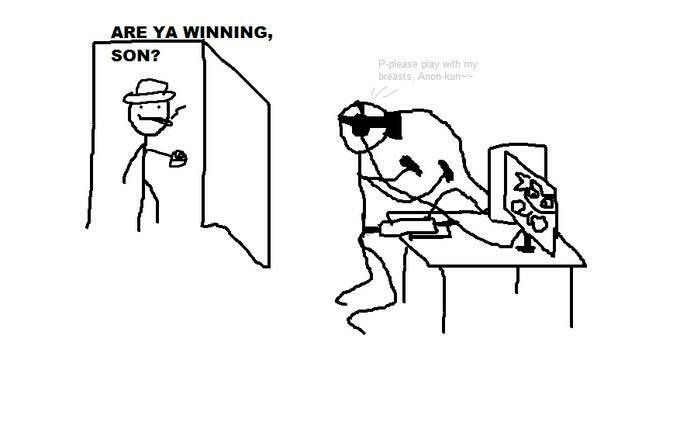
The drawing is hand-made in the simplest graphics editor: black outlines on a white background, with no fill. On the left, a little figure in a hat, with a cigar in his mouth, peeks out of the doorway, one hand lowered and holding something. Above him, in large black letters, it reads “ARE YA WINNING, SON?”, that is, “Are you winning, son?”
On the right, the hero hunches at a desk. He wears dark glasses, one hand reaches for the keyboard, and the monitor shows a game window. A light gray caption above him states what is happening on the screen, a hint that the game is not meant for a father's eyes. The details are optional: it is immediately clear that the son is busy with something he would prefer to hide.
When and how the meme appeared
The drawing appeared in January 2014 on a forum devoted to computer role-playing games. The author is unknown. It then spread to English-language humor sites and communities, among them FunnyJunk and a themed section of Reddit.
Early remakes were grim. On them the son “melts” into the computer or shows that the computer has consumed his life, while the father remains a helpless observer. Such jokes reflected the common image of the gamer as a withdrawn person, and parents' fear of something they did not understand.
How the meme became kind
By 2020 the tone had changed. Increasingly, images showed a happy boy and an enthusiastic father who does not condemn but joins the game. A reversed version also emerged, “Are Ya Winning, Dad?”, in which the father sits at the computer and the child asks how the game is going.
This accurately reflects a shift in attitudes toward video games: for many families they went from a “problem” to a shared hobby. The old joke did not disappear but got a second life, and today the template can be either sad or warm, depending on the caption.
Caption examples
Three invented variants, where the question is asked by someone who knows nothing about the hero's activity.
“Are you finishing your project there, son?” “No, Dad, I'm watching the cat fall off the couch for the eighth time.” A contrast between a serious expectation and a trivial activity.
“Are you winning there, son?” “No, Dad, I've gone to the fridge for the third time tonight.” Instead of gaming, the hero is busy with food, and the naive question sounds like concern.
A variant for the new wave: on the left a son, on the right a father at a console, with the caption “Dad, are you winning there?” The mirrored swap of roles turns the joke into a family portrait.
How to work with the template
The strongest captions are those where the naive question is in the left line and the right line shows that reality is far from expectations. It is enough to replace the words “winning” and “son” with the ones you need. You can keep the English inscription in the drawing and translate only the caption, to preserve recognizability.
The drawing contains an indecent line from the screen, so when publishing in shared channels it is better to remove or cover it. Grim versions about addiction and the harm of games are better not developed: jokes on that theme easily hurt people who actually face it. The universal and safe route is the warm version, where an awkward question becomes a reason for a shared game.