Description
"Dying in Piter" is a meme that plays on the name of the "Piter" coffin model. The joke rests on combining two themes: dark humor about death and the widespread wish to move to St. Petersburg. The model's name comes from a shortened form of the city's name, and that's exactly what became the basis of the pun.
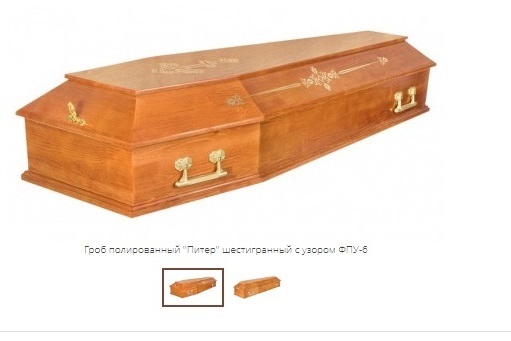
The illustration from the catalog shows a polished hexagonal wooden coffin with a carved pattern and brass handles. The caption under the photo gives the model as "Piter" and the code FPU-6. This is a photo of a product from a funeral supplies catalog, not a staged shot for the meme.
Origin
The meme's origin hasn't been established. A search by name and description turned up neither a first publication, nor an author's name, nor an exact date. The materials found related to other topics and had no connection to this joke, so they can't be used in the article.
The catalog lists the year 2017. This date is given as the catalog's data, without independent confirmation. The meme likely arose from the combination of an already existing model name and the popular phrase about moving to St. Petersburg, but this is a conjecture rather than an established fact.
The point of the joke
The meme's key move is a shift in meaning. The phrase "dying in Piter" sounds like a wish that ironically flips the usual dream of living in the city. Death, meanwhile, stays a mundane, almost businesslike matter: it's about a product with a catalog number.
The humor belongs to the dark-humor category: it plays on the contrast between a lofty wish and the plainness of a funeral product. There's no targeted mockery of specific people or their grief here; the joke is built on the name and the wordplay.
This kind of wordplay is typical of the Russian-language internet, where puns based on place names often become the basis for memes. Apparently, it was precisely the simplicity and clarity of the pun, requiring no further explanation, that determined its rapid spread.
Spread and use
The meme usually appears as a picture of the coffin with a caption. This format is convenient for online discussions, where joking about moving and about cities is customary. The caption can be changed while keeping the structure, so the template is easily transferred to other cities and names.
In chat, the phrase serves as a reaction to conversations about moving to St. Petersburg or to stories about city life. The irony works through recognizability: it's enough to see the model's name to understand what the joke is about.
Judging by the description, the meme has become established as a fixed expression and is used separately from the coffin photo itself—it's enough to say the phrase for the listener to get the reference, even without seeing the catalog's original image.
Does the image match the description
The image matches the catalog's description: it does show a coffin named "Piter." There's no discrepancy. However, the shot isn't part of the meme itself; it serves as an illustration of the object of the joke.
The article relies on the catalog's data and description. Information about the original source remains unconfirmed, and this should be kept in mind when publishing.