Two portraits
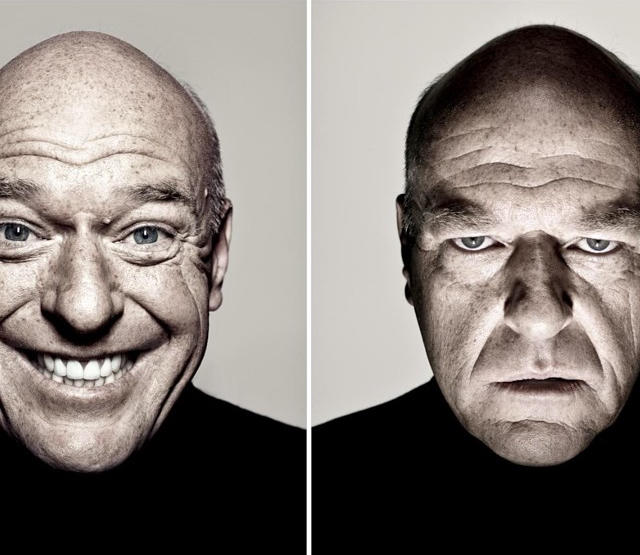
The image consists of two vertical monochrome portraits in warm grayish tones, placed side by side. On the left is a bald man with a very wide smile, wrinkles around the eyes and light eyes; the light is soft. On the right, the same man is photographed under harsh side lighting: a brooding look from under the brows, downturned corners of the mouth and deep shadows. The background is light and the clothing dark.
The contrast is deliberate: identical framing and background emphasize that only the facial expression changes. This makes the template readable at a glance.
Who took the photos and where they came from
The photos were taken by the photographer Marco Grob. They are known to have appeared no later than 14 July 2014, when Dean Norris himself posted them on social media. He is an American actor who became widely known for playing Hank Schrader, a Drug Enforcement Administration agent, in the series Breaking Bad.
The paired portraits first circulated as ordinary photos of the actor, with no joking meaning.
The path to the meme
An early known use dates to 13 April 2017, when an Instagram page devoted to the series posted a version showing “what people look like before and after being called beautiful”. It collected many likes at the time but did not become a common template.
The template spread widely in April 2021 as a two-panel reaction. One of the first viral versions compared two everyday actions, which showed that the format suits any “pleasant / unpleasant” pair. These details rest on a single meme database found, so the month of the mass spread is worth double-checking.
How to read the joke
The structure is simple: the left panel is what brings joy or approval, the right is what brings irritation. But the funniest part is pairing very similar things, where the difference in feeling is out of proportion. The closer two items are in meaning, the stronger the effect.
Norris's face helps because both emotions are expressed without halftones: the smile is almost theatrical, and the gloom is just as clear. Viewers read them instantly. The fame of the actor's best-known role also plays a part: many know him from the series about a chemistry teacher turned drug manufacturer and see his face as serious, so the broad smile on the left looks unexpected. But the joke itself does not depend on the series' plot, and knowing it is not needed to understand the joke.
Caption examples
Left caption “Hot tea”, right caption “Lukewarm tea I forgot about”. The object is the same, but the reactions are opposite: the joke shows how little it takes to be disappointed.
Left “Delivery notification”, right “Delivery notification: tomorrow”. A one-word difference makes the change of mood comic.
Left “Sleeping in on Saturday until lunch”, right “Alarm at seven a.m. out of habit”. The image is recognizable and good-natured.
Left “New episode of my favorite show”, right “A spoiler from a friend”. The emotional drop works through surprise.
Practical tips
Pairs work best when they differ by a single detail. Place captions above the faces or at the edges so as not to cover the eyes and mouth.
The template suits self-irony well. Captioning real people with it is inappropriate, since the “pleases / upsets” contrast is easy to read as a judgment of the person.
You can also build chains: start with a “pleases / upsets” pair, then continue in the comments with items that are even closer in meaning. This way the joke develops without losing its simplicity: the face on the left always means pleasant, and the face on the right means unpleasant.