What is shown in the picture
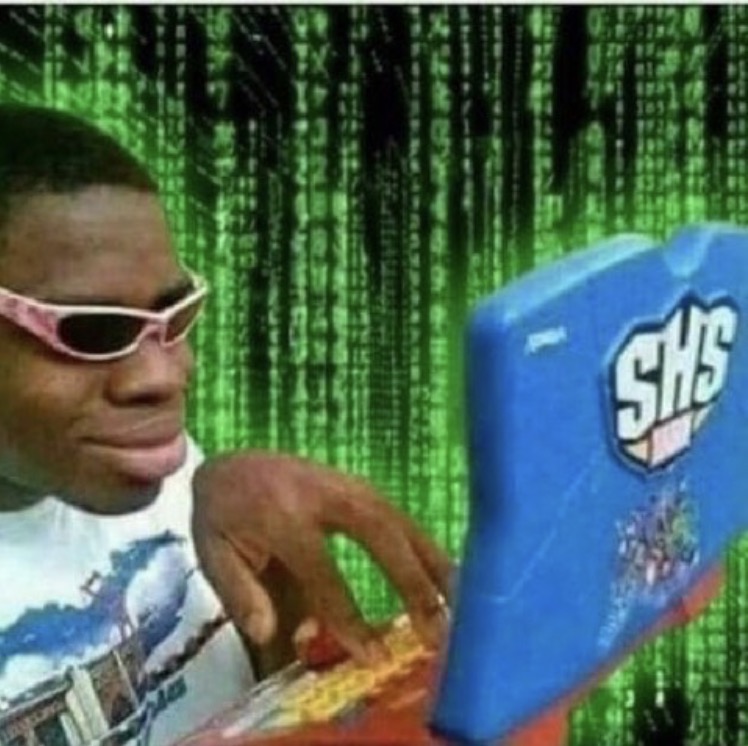
The picture shows a young man in pink sunglasses and a graphic T-shirt, staring intently at a screen and pressing keys with his finger. The device in front of him is not a real laptop but a children’s toy: a blue plastic body, large multicolored buttons, a manufacturer’s logo, and the garish graphics typical of educational electronic toys for kids. The background was digitally overlaid on the original photo and styled as a “rain of symbols,” a visual nod to the title sequence of The Matrix, which is often used as shorthand for hacking.
Origin
The source of the original photo of the young man in glasses has not been reliably established. Such pictures are often taken from random amateur photos posted on social networks, after which authorship is lost through repeated reposts. The version with the “Matrix” background and the toy laptop began spreading on the Russian-language internet and on foreign imageboards around 2014. This date appears in descriptions accompanying the meme, but there is no independent confirmation of the exact date of first publication.
The combination of a serious, focused expression and an obviously unserious “tool” (a kids’ toy instead of a real computer) is the comic device that turned a random photo into a recognizable template.
Why the picture became a meme
The key mechanism of humor here is the mismatch between form and content: the man’s pose and expression read as “a real hacker at work,” while the object in his hands is an obviously unserious toy for preschoolers. The added background of “Matrix” symbols amplifies the contrast, explicitly invoking the Hollywood image of the cybercriminal, and makes the absurdity even more obvious.
This deadpan presentation of a plainly unserious action is characteristic of a whole class of memes about “unserious hackers” and is used to mock any pseudo-technical posturing.
How the meme is used
The picture gets posted when someone wants to tease another person for clearly insufficient technical means or skills that are presented as something serious. Typical captions include “Me when my friends ask me to hack the bully’s page” or “A company’s tech support two hours into their shift.” Both play on the gap between the stated task and the character’s real capabilities.
The meme is also used more broadly as a reaction to any situation where someone takes on a hard task with an obviously unsuitable tool, even one unrelated to computers.
The meme’s place in internet culture
The image belongs to a large group of “hacker” memes that parody the movie image of the cybercriminal (dark glasses, a focused gaze, streams of symbols on the screen) by setting this image against absurd reality. Such templates have been used for more than a decade to humorously comment on internet security, unserious hacking threats, and exaggerated claims of technical skill in chats and forum arguments.
Over the years the picture has repeatedly resurfaced in “best hacker memes” roundups on Russian-language and foreign entertainment sites, where it is usually cited as an example of a successful visual pun: a serious claim of cybercrime ends with a kids’ toy instead of real equipment. These constant reprints in compilations are a big part of what keeps the image recognizable years after it first appeared online.