Two frames, one reaction
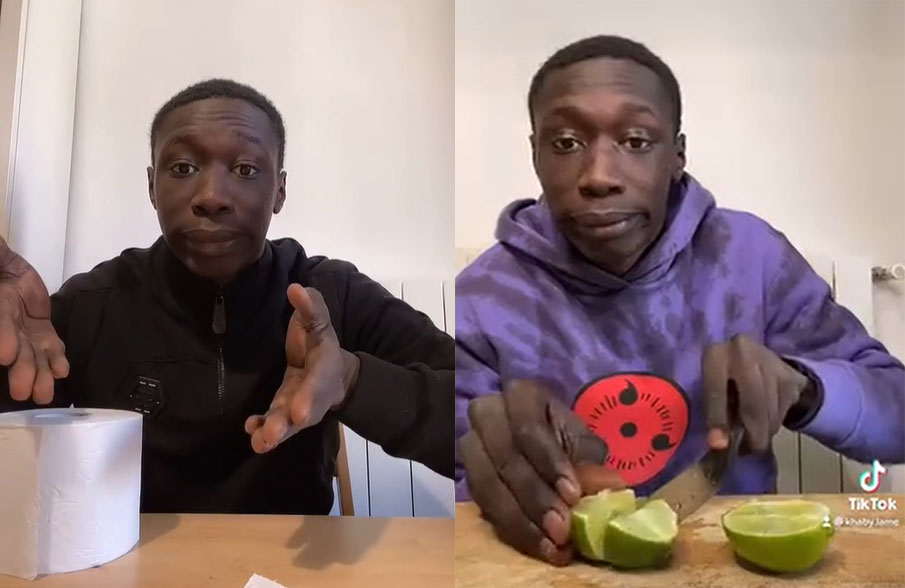
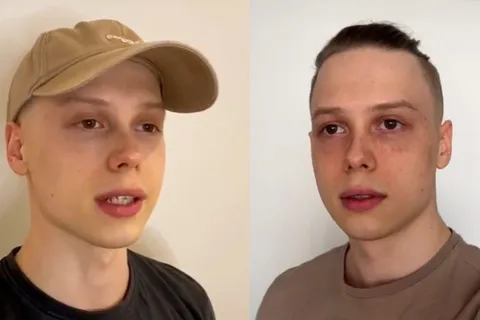
This meme is a collage of two frames. On the left, a young man in a black hoodie sits at a table in front of a white wall with his palms spread open, and a roll of toilet paper lies on the table. On the right, he wears a purple sweatshirt with a red and black round emblem and cuts a lime on a wooden board. In the lower right corner, the TikTok logo and an account name are visible.
His expression is the same in both: calm, slightly weary, with raised eyebrows. What he does with the toilet paper cannot be made out from the picture, so it is better to read this template through his manner rather than through any particular video.
From the factory floor to the most popular account
According to an English-language reference, Khaby Lame was born on March 9, 2000, in Dakar, Senegal, and at the age of one moved with his family to Italy, to Chivasso near Turin. Before blogging he worked as a CNC machine operator at a factory. In March 2020, at the height of the pandemic, he lost his job and started posting on TikTok, first with dances and games.
His breakthrough came with replies to complicated “life hacks” using the duet and stitch features: he repeated the same action in a simple way, said nothing, and ended with a gesture. According to the same sources, in April 2021 he overtook Gianluca Vacchi as Italy's most popular TikToker, and in June 2022 became the platform's most-followed creator with 142.1 million followers.
Why without words
In an interview with CNN, he explained the choice this way: he needed to reach as many people as possible, and the best way was not to talk. Without words there is no language barrier, so his videos are understood in Italy and in Russia alike.
His signature gesture is open palms turned upward, often with an eye roll or a shake of the head: “couldn't you just do it like that?” That gesture is what became the meme.
How the joke is built
The formula has three steps. First, an overcomplicated solution to a simple task is shown. Then the same result is achieved in a second with no gadgets at all. Finally comes a silent reaction that explains nothing, and so it sounds louder than words.
The meme is also applied to inanimate situations: any “clever instruction,” tangled diagram or excessively long explanation gets the same punchline.
Caption examples
“Twelve-step instructions for turning on a printer.” The template shows the absurdity of excessive complexity.
“My coworker wrote a twenty-page report when the answer is ‘yes.’” The caption plays on the contrast between volume and content.
“Me when someone explains that a door should be pulled, not pushed.” The hero is the viewer, and the gesture reads as self-irony.
“The app asks me to confirm I'm not a robot for the fifth time in a row.” A modern irritating situation that everyone recognizes.
How to use it
It suits jokes about excessive complexity, but not mockery of specific people: aim the gesture at the scheme, not at a person.
Do not attribute words or beliefs to him. The template describes his manner, not an opinion on your topic.
The reverse also works well: instead of a silly life hack, show a complex problem that has an elegant, quick solution. Then the gesture reads not as mockery but as delight that it all turned out to be simple. If a caption runs longer than two lines, the joke usually loses its speed: the main effect comes from the silence.