Who's in the shot and what it shows
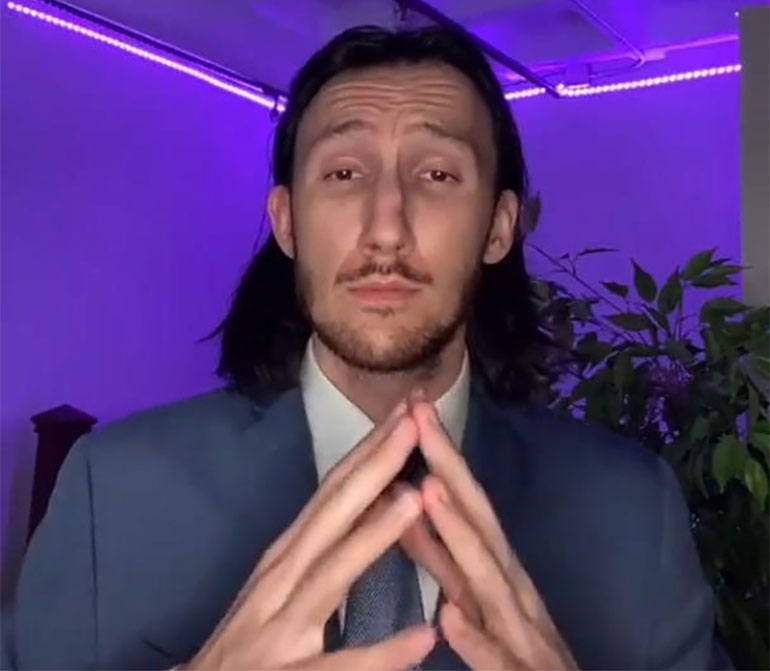
The shot is taken from a video without a caption. A man with long dark hair, a mustache, and a short beard looks into the camera slightly from under his brow, with half-closed eyelids and a barely noticeable smirk. He's wearing a gray-blue jacket, a light-colored shirt, and a tie. His fingers are steepled in front of his chest — the pose of someone negotiating or scheming something.
The background is bathed in purple light from an LED strip on the ceiling, with the leaves of a houseplant visible on the right. The setting looks like a home recording rather than a studio. Who exactly this person is and what video the shot is taken from can't be determined from the image itself, and there's no reliably confirmed information about it. For understanding the joke, the name doesn't matter — what matters is the pose and the facial expression.
How the format emerged on TikTok
The earliest example found is a video by the user @natebellamy4 from November 12, 2020. He used the melody from the NBA draft intro and offered "a trade with God." The clip collected hundreds of thousands of likes, but the format only became mainstream later.
The real growth began in March 2021: on March 8–9, several similar videos appeared at once, and on March 18 the user bradeazy posted a version that became the main template for imitations throughout March and April. By the end of the month, the format was already circulating on Reddit, Instagram, and iFunny. Three things should be kept separate: the date of the earliest video found, the moment the template started being repeated, and the period of real popularity — these are different dates, and the first of them is merely the earliest one found, not a proven "first in the world."
Where the joke itself comes from
The format parodies the trade window in video games and sports management simulators. There, two columns show what you get and what the other side gets, and the game asks you to confirm or decline the deal. In the memes, the columns became the phrase "I'll get — you'll get," and the role of the confirmation window is played by the other person's grimace.
The sports angle of the joke matters too: player trades between teams are discussed seriously, with numbers and analysis. The meme borrows that tone and plugs in mundane or ridiculous "assets," from someone else's portion of food to one's own birthday.
How the imbalance works
It gets funny when the exchange is so unfair that it's obvious to everyone except the speaker. He himself carries on like a seasoned negotiator, so the contrast between the confident tone and the content of the deal does most of the work. The second device is a scale mismatch: one column holds something enormous, the other mere pennies, or the other way around.
The third device is a "deal" without any actual offer: the person simply describes what's convenient for them and calls it a fair exchange. The more businesslike the delivery, the stronger the effect.
Caption examples
"I'll get: your last slice of pizza. You'll get: my sincere respect." Here the partner gets an intangible bonus that can't compare to actual food.
"I'll get: a day off. You'll get: the chance to say it was your idea." A joke about a boss who offloads the consequences onto a subordinate and calls it a gift on top of that.
"I'll get: your streaming password. You'll get: the right to a link to my recommendation." The imbalance arises because the promised benefit is empty while the demand is entirely real.
"I'll get: the window seat. You'll get: a view of my back." A version where the second column turns out to be a joke at one's own expense rather than a loss.
How to use the shot
A caption works best split into two lines with the same opening, so the reader immediately recognizes the format. The joke benefits when the second line is shorter than the first and sounds like the final word in a negotiation. The steepled-fingers pose suits situations where the speaker clearly thinks they're smarter than the other person.
The deal shouldn't be made too convoluted: the viewer needs to see who's coming out ahead within a second. If the trade needs explaining, the format breaks.