Political assessment gets a new formula
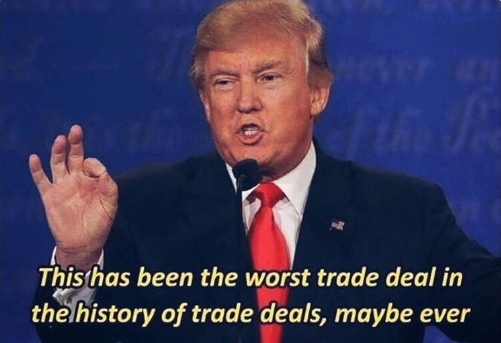
At the first presidential debate with Hillary Clinton on September 26, 2016, Trump criticized NAFTA, the free trade agreement among the United States, Canada and Mexico. He called it the worst trade deal and linked it to the state of American manufacturing. This was the position of a participant in a political dispute, not a neutral assessment of all treaties. The meme took from the speech the recognizable face, the energetic delivery and the ready-made idea of an extremely disadvantageous deal.
The caption on the macro is not a verbatim transcript of the remark. It reworks it into a formula with deliberate repetition about the history of trade deals and adds a final “maybe ever.” One of the early documented variants was published by the memegourmet Instagram account on December 27, 2016: expensive Christmas gifts were compared with a modest return gift. In January 2017 the image was used on Twitter and Instagram, and then variants appeared on r/funny and r/dankmemes. The date of a particular post found does not prove the author's absolute priority.
The speaker's gesture and the yellow caption
Trump is shown against a blue background with a microphone near his mouth. He wears a dark suit, white shirt, red tie and a small flag pin on his lapel. The raised hand joins the thumb and index finger, while the other fingers stay extended. The mouth is open mid-speech; the face looks focused. Two lines of yellow italic English text are placed in the lower part of the image.
The close crop leaves the viewer with the speaker and his assessment, removing almost all the debate context. That is why the caption above the picture can set a new subject of conversation, while the lower lines look like a ready verdict. The gesture adds a sense of certainty to every word. Yet the macro itself does not show a deal, a purchase or a gift: it conveys an attitude toward an event that the author of the new joke has to name separately.
A small loss becomes a historic failure
The core construction compares the two sides of an exchange. The narrator gives up time, money, effort or a desired item and gets something disproportionate in return. The inconvenience may be quite small, but the solemn formula declares it a failure of world scale. Repeating the word “deal” makes the assessment deliberately heavy; the closing extension of the comparison strengthens the impression that no worse example could be found after such an exchange.
From here it is easy to come up with jokes about friendly arrangements and one's own mistakes. You can trade away your last tasty bite, take on an extra task in exchange for a promised favor, or spend an evening on dubious entertainment. Trump's role here is that of a generic commentator on disappointment. The caption does not require sharing his views on NAFTA: the political speech supplies the intonation, while a new event creates an independent reason for a comic complaint.
Three invented unfavorable exchanges
Fictional example: “Gave a friend my last slice of pizza in exchange for a promise to pick a good movie. Now we're watching an ad for a new vacuum cleaner.” The first line sets up the exchange, and the second shows why the result seems bad. Another scenario: “Traded my window seat for ‘there will be more room for your legs’ and got a folding chair next to the luggage.” The historic scale of the verdict contrasts with the ordinary discomfort of a trip.
A third variant: “Spent two hours helping look for a phone, and the reward was a call from that phone to check whether I can be heard.” These stories are invented and do not describe Trump's real deals. In each case there is a concrete contribution and a concrete result. This pairing distinguishes the format from a general picture of irritation: the viewer understands exactly what the person gave up and why they now consider the exchange comically unfair.