What's shown in the shot
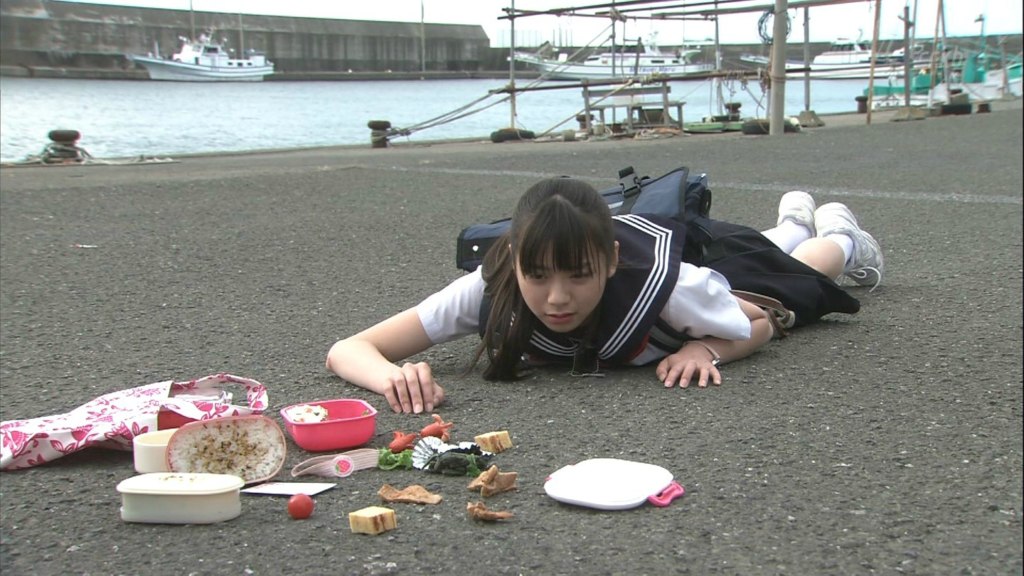
A paved waterfront, with water and a few boats moored at a dock in the background. A girl lies on the ground in a dark sailor-style uniform with white trim, a blue backpack on her back, white sneakers on her feet. She has propped herself up on her arms and is staring straight ahead, at the ground.
Spilled in front of her is a lunch: a pink box, a clear container of rice, a lid, slices of food, small vegetables, and a bag with a floral print. Her expression is sad, almost tragic, but without drama — it's the quiet dismay of someone whose whole day has just fallen apart.
Where the shot comes from
According to an English-language meme encyclopedia, the stills are taken from the 2008 Japanese TV drama 'Love Letter' (ラブレター), in which the heroine drops her bento. The image's first known appearance online is traced there to January 31, 2010, on a Japanese forum; it was first spotted on Reddit on July 9, 2012, and in March 2013 a well-known example about Instagram food photos appeared.
This information should be treated with some caution: it rests on a single source, and the drama itself isn't examined in detail. The actress's name isn't given — the shot is used as an image of the character, not as a portrait of a specific person.
How the meme became a 'whose fault' template
The main push came on July 27, 2015, when a version captioned 'Arigatou Obama-san' — that is, 'Thank you, Obama' — appeared on Imgur. It paired with the already-existing 'Thanks, Obama' template, in which minor misfortunes are jokingly blamed on the politician. The picture was a perfect fit: the victim is lying on the ground, the lunch is spilled, and she'll name the one at fault herself.
From there the format spread across all kinds of topics. People blamed politicians, historical figures, neighbors in online communities, characters from fandoms. So the template should be read as a blank slate: the caption always explains who's being blamed and for what, while only the addressee changes in the picture itself. A separate category of jokes uses the scene itself as an image of something lost — the spilled result of a long effort.
It also matters that there's no anger in the shot. The heroine looks more bewildered than furious, so captions with excessive aggression don't pair well with the picture — a tired, almost polite grievance works better.
Example captions
'When they updated the service and hid the support button in a third-level menu' — next to the line 'Thanks, developers.' The joke runs on polite anger: the word 'thanks' in a caption like this means the opposite.
'My weekend plan was perfect. Then the weather showed up.' Here the one at fault is something vast and uncontrollable, and the absurd scale makes the caption funnier.
'Saved up for three weeks for the sale, and the item sold out in a minute.' The shot of the spilled lunch tells the story of a missed reward all on its own.
'Wanted to go to bed early. One track left on the playlist — and suddenly it's three in the morning.' The culprit is one's own weakness, which makes the joke self-deprecating.
Interestingly, the picture has outlived the era that made it famous: 'Thanks, Obama' jokes went out of fashion long ago, but the shot stuck around, because it rests on a universal gesture. A person kneeling before a spilled result, looking for someone to blame. The viewer doesn't need to know the drama — the pose, the pavement, and the scattered containers are enough.
How to use it
The template works best with small everyday misfortunes rather than real tragedies: the scale of the mishap should match a spilled lunch. The caption goes next to the girl or at the bottom of the shot, and the name of the 'culprit' is stated directly.
This picture shouldn't be used to pin serious wrongdoing on real people: the format is built on exaggerated everyday grievance, not actual accusation.