A stern portrait and a strange caption
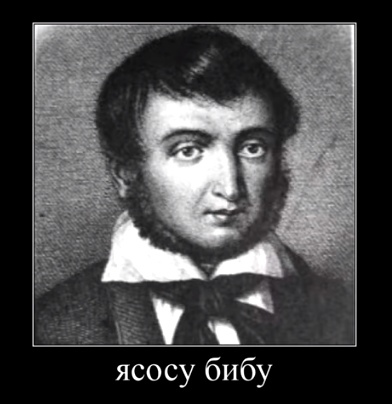
The image is styled as a classic demotivator: a black background, a thin light border around the photo, and a large white caption at the bottom reading “[expletive]”. Inside the frame is an old black-and-white image resembling an engraving or a heavily grainy reproduction. A young man with dark wavy hair and sideburns looks slightly to the side; he wears a white collar and a dark scarf tied in a bow.
Who exactly is pictured does not matter for the joke and is not established here: the image serves only as a “serious scholar.” Naming a real person is not advisable. What matters is only that the face looks old-fashioned and dignified.
How the sound-alike works
The whole effect is built on wordplay. “Yasos Biba” sounds like the name of a Polish or East European thinker. But once it is put in the dative case, as in the picture’s caption (“[expletive],” “dedicated to the philosopher…”), the two words merge by ear into an ordinary Russian phrase with a crude first-person meaning. A listener repeating the “clever” name aloud unwittingly says something obscene.
This is a trap joke of the same kind as school pranks built on “tricky” names: the victim does not realize it until they hear their own voice. The portrait is there to lend the trap plausibility: a serious face, a scholarly look, a “historical” caption.
Where the philosopher came from
Sources differ on the details. According to reports, similar sound-alike pranks circulated on the Runet long before this, and as a distinct meme the joke gained recognition in 2018–2019, resurfacing in February 2021 when an episode spread online in which a teacher in an online class, not noticing the trick, repeated the “name” aloud. The details of that episode are not reliably confirmed.
There are also joke “biographies” of the philosopher that assign him various nationalities and professions. These are deliberate fabrications in the genre of absurdist encyclopedias, not historical data. No real thinker with this name existed.
Captions and situations
The meme is used in two modes: as a prank in personal conversation and as a picture with a jab. Some invented examples follow.
“Today at the lecture I heard about the philosopher Yasos Biba for the first time. Write it down, it will come in handy.” The joke is that the listener is about to say the name aloud too.
“Best answer on the philosophy exam: ‘Yasos Biba, of course.’” The contrast between the exam and the absurdity is immediately clear.
“When I slipped an unknown thinker’s quote into my report, and the teacher asks me to repeat the surname.” Here the caption shows how the prank turns against the prankster.
“I’m reading the works of Yasos Biba, and I recommend them to all my friends.” The caption invites friends to repeat the name, and the trap snaps shut.
Why the trap still works
The effect rests on two things. The first is the serious tone: the more official the presentation, the stronger the awkwardness when the meaning of the sound-alike sinks in. The second is the victim’s participation: the person says the text themselves, so the embarrassment falls on them, while the prankster appears blameless.
Because the joke lives in sound, it is weaker in written form: the reader sees the words separately and immediately notices the trick. The portrait solves this problem by adding visual seriousness.
How to use the image
The portrait works best in chats where participants know the genre and are ready to laugh at themselves. The dark frame and white letters are legible even as a thumbnail, so the text can stay unchanged. It is enough to add a question like “What do you think of the philosopher?”
Keep in mind that the joke relies on a coarse phrase, so do not send it in work or school chats without understanding the audience. There is no need to tie a real person from the portrait to it: the meme’s plot is a fictional philosopher, not someone’s biography.