The cat appears in a thought experiment
In the article “The Present Situation in Quantum Mechanics,” published in 1935, Erwin Schrödinger devised a sealed chamber in which the random decay of a radioactive atom triggers a poison mechanism. If decay occurs, the device kills the cat; if not, the cat remains alive. Until the check is made, the quantum description links the system to both outcomes. Schrödinger deliberately chose a vivid, almost absurd example to show how unfamiliar such a description sounds when it is carried from the atom over to an animal and the whole everyday world.
The cat was not proposed as a laboratory procedure to be carried out, and the experiment does not claim that an ordinary observer simply does not know whether the pet is alive. At its center is the question of how the mathematical description of a microscopic system, the measuring device and the result we see are connected. It is precisely the everyday clarity of the image that makes it convenient for discussing complex physics: the box hides the outcome, and the imagination fills it with two incompatible endings.
Why this is not a literal puzzle about a pet
The popular retelling often reduces the idea to the formula “the cat is both alive and dead.” This is easier to remember, but such a phrase loses the critical point. Schrödinger proposed mentally linking a large animal to a quantum event, thereby making visible the paradox that arises from literally extending quantum superposition to an entire macroscopic scene. A real cat does not turn into a strange creature of two states just because the box is closed to a human observer.
Later, physicists developed different approaches to measurement, interaction with the environment and the loss of observable interference. For the meme, it is enough to remember a narrower thing: the cat’s name has become a short symbol for a state in which alternatives remain open until checked. But the scientific formulation and the everyday “I don’t know what’s inside” do not fully coincide. In everyday life a person usually simply lacks information; the thought experiment sets up a special quantum model and its difficult application to a large object.
The demotivator adds its own punchline
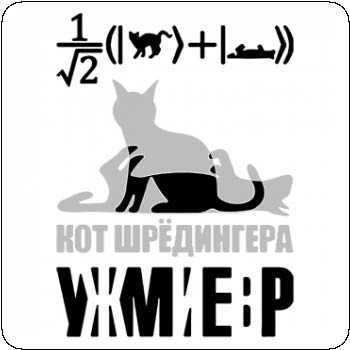
In the picture, next to the formula, it is written that the cat is already dead. This changes expectations: instead of textbook uncertainty, the viewer sees one chosen outcome, delivered bluntly and without any explanation of who opened the box or why. The black-and-white illustration and the look of the notation in brackets recall a scientific diagram, while the sharp caption cuts through its serious tone. What results is not a new version of physics but a short joke about how a familiar formula is turned into an unambiguous everyday punchline.
The phrase “Schrödinger’s cat” has long lived in conversation as a label for a situation with several possible outcomes. But this demotivator picks out one and presents it as a dry conclusion. The contrast between the notation of a state and the categorical verdict is its extra comedy: the complex topic promises to leave the options open, while the caption closes the question without ceremony. The exact author and the early publication of this Russian picture are not confirmed, so what is dated here is the scientific source of the image, not the appearance of this particular layout.
The examples are invented
Invented caption: “A closed box with a parcel: inside is either the long-awaited headphones or yet another adapter.” Here the expression works as a playful anticipation of a check, not as literal physics. Another example: “The team has not yet opened the results spreadsheet: the project is both delivered and in need of urgent fixes.” In both cases the unknown creates two outcomes, but the situations themselves are ordinary and have nothing to do with quantum measurement.
Third variant: “The cat is sleeping in its carrier before the trip; the owners are arguing over whether it will stay silent or comment on every turn.” Here Schrödinger’s image turns into a light everyday forecast. If, however, the caption simply says “I don’t know what will happen,” the reference to physics may be superfluous: a recognizable phrase gives the joke a specific flavor only when alternatives or the moment of checking are actually shown nearby.