Source material
The animated film "Shrek" came out in 2001 and quickly became one of the most frequently quoted animated films. The main character is an ogre living in secluded isolation in a swamp, who values peace and quiet. His character, gruff lines, and desire to keep outsiders off his territory are easily transferred to any situation that calls for expressing a desire for isolation.
Shrek's image has long become a universal template for memes: individual lines are used as captions for pictures, and the character himself serves as a mask for an ironic statement about oneself. It was precisely this flexibility that allowed him to be transplanted into a completely different historical context.
Peter I as a meme character
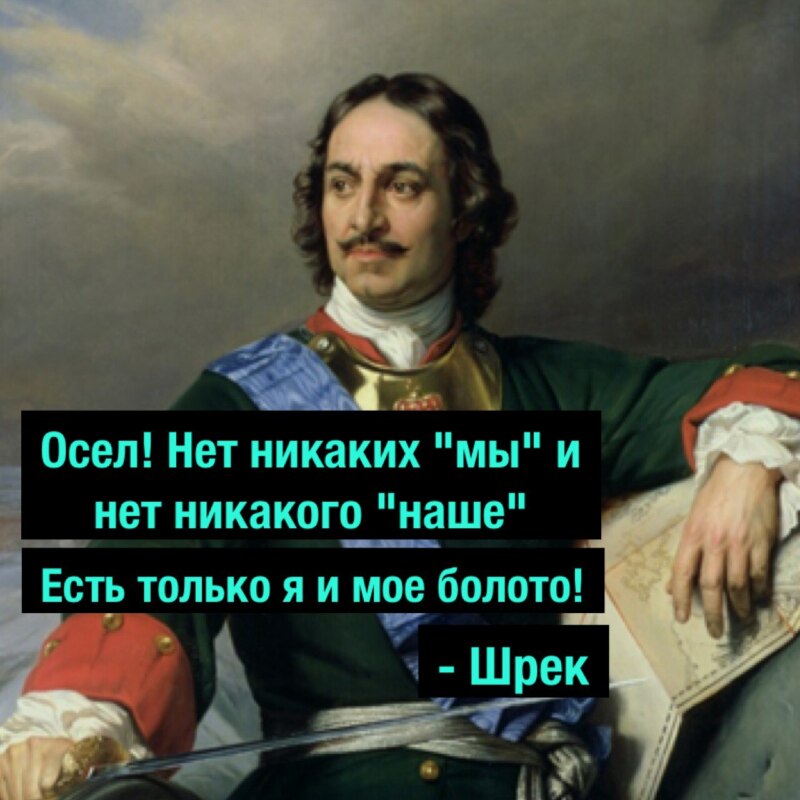
Peter I, who reigned from 1682 to 1725 and founded Saint Petersburg in 1703, remains one of the most famous figures in Russian history. His portraits are often reproduced in textbooks and museums, so viewers instantly recognize the image of the tsar in a caftan with a blue sash.
In the pictures of this series, the portrait is used as a serious backdrop, while text in Shrek's style breaks the solemnity. The contrast works flawlessly: a monarch posing in armor unexpectedly gets a line about a swamp and a refusal of the royal "we," which references the character of the cartoon figure.
The swamp as a historical hint
The key joke rests on a well-known fact: Saint Petersburg was built on the swampy banks of the Neva, and construction proceeded under harsh natural conditions. Combined with the phrase about "my swamp," the joke turns into an ironic comment on the very founding of the city.
The phrase "there is no we" can be read two ways: as the image of a sole ruler who makes decisions himself, and as a reference to the familiar depiction of Peter as a lone reformer. The meme doesn't require historical knowledge, but it gives a knowledgeable viewer an extra layer of meaning.
Spread online
The series spread in Russian-language communities in 2017, where pictures with captions were published in sets. Such sets are easy to multiply, because each new variant only requires replacing the portrait or the phrase.
The exact original source of the series could not be established. The first versions probably appeared in themed communities where memes with historical figures and film quotes were popular. For this reason, no specific author or date of first publication is given. What matters is simply that the pairing of character and portrait caught on and keeps being reproduced.
Significance and variations
The meme shows how Russian-language internet culture combines school-level history, mainstream animation, and everyday humor. The monumental image of the tsar becomes understandable and funny thanks to a familiar movie quote, while school knowledge adds extra weight to the joke.
Variations of the series include changing the portrait, translating the phrase, and captions about modern-day situations. Such pictures are usually used in comments to ironically describe isolation, excessive self-confidence, or a desire to decide everything on one's own. The tone stays playful, without political jabs. These captions should be read as play with imagery rather than an assessment of the tsar's historical role.