The portrait has not said anything yet
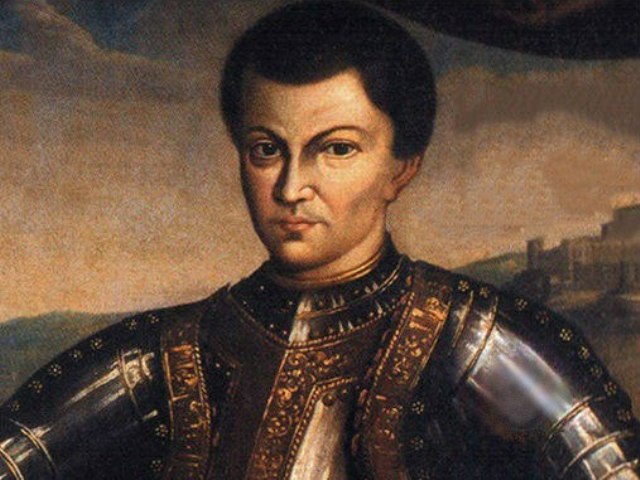
The picture shows False Dmitry: a man with dark hair, a small beard, and a serious gaze. Armor plate gleams with metallic bands; over it are golden ornaments and a patterned collar. In the background are a landscape and buildings. This is a single painted portrait with no modern text, a ready basis for attaching a line rather than an already finished quote card.
Formal dress gives the image weight. The viewer expects a biographical caption, an important historical statement, or a date, but the meme places in that spot words from an ordinary chat. The serious face stays the same, and it feels as if the man utters an absurd promise with royal confidence. The caption changes the picture's role without changing its expression.
A short history of the new role
The notable Russian wave of such cards dates to late February and early March 2018. Among the known early platforms on VKontakte were “Quotes of the Not-So-Great” and “Orlyonok.” At first Charles the Bold played a prominent role, then False Dmitry, Yaroslav the Wise, and other characters were added. The remakes spread through entertainment communities and Pikabu; the undisputed single inventor of the format has not been established.
False Dmitry I occupied the Russian throne in 1605–1606 and passed himself off as Tsarevich Dmitry. In historical memory his name is associated with impostorship. The meme uses this association as a brief characterization of a modern interlocutor. At the same time, the story of yet another unpaid debt or a forgotten passport refers to an invented internet character, not to a documented speech of the tsar.
A nickname instead of a long biography
The format works as a game with a ready-made label. The prefix “false” promises unreliability, “the Wise” suggests down-to-earth prudence, “the Bold” suggests daring. A school-textbook name becomes almost the title of a role in a comedy. Sometimes the nickname alone is enough to understand the joke, even if the viewer does not remember the events of the reign or the origin of the portrait.
A double effect arises from this. First the phrase looks like a quote, because a recognizable name and old painting sit beside it. Then its vocabulary, everyday plot, or a direct hint at invention reveals the substitution. The comedy rests on the collision between the form of an authoritative statement and the content of a short message to a friend. Implausibility here helps one recognize the parody.
This device has a special narrative economy. The image already gives the speaker status, and the name supplies the expected habit. The entire new story can consist of a single sentence. If False Dmitry promises to finish work tomorrow, the viewer imagines not only today's promise but also the earlier postponements, though none of them is shown. The portrait becomes the face of a familiar type of behavior.
Three new invented quotes
For False Dmitry one can invent: “I've already left, I'm just looking for the second sock.” This is a deliberately fabricated line about a person who reports success before the action. The royal portrait turns a small everyday lie into a solemn declaration, and the specific sock destroys its majestic look.
A new variant with Yaroslav the Wise: “First check whether your glasses are on top of your head.” The advice is simple and almost funny in its obviousness. Attributing it to a ruler elevates everyday checking to ancient wisdom; the joke depends on the nickname, not on any historical statement by Yaroslav.
The third scene uses Charles the Bold: “I press ‘refresh’ without saving the document.” Here daring means risk for a negligible gain in time. The imagined caption makes a serious historical figure share the habit of a modern user. All three lines are created as parody examples and are not words of the people depicted.