What the image shows
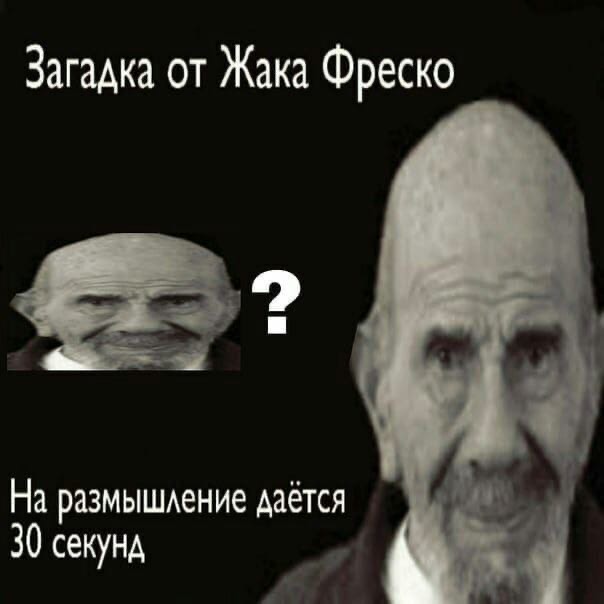
The background is deep black. In the top-left corner, in white letters: "A riddle from Jacques Fresco". On the lower right, a large face of an older bald man with gray stubble and a serious gaze, in gray tones. On the left, smaller, the same face with a slight smile, and beside it a large white question mark. At the bottom left: "You have 30 seconds to think it over."
The design recalls motivational posters and videos: a dark background, a portrait, a line of text. But instead of a quote there is a question, and the template invites you to put your own text in its place.
Who Jacques Fresco was
Jacques Fresco (1916–2017) was an American designer and futurist, the author of The Venus Project. He described a society without money or private property, where resources are managed by technology and labor is done by machines. His lectures and videos are also known on the Russian-speaking internet.
The template itself does not mock his real views: it takes a face with a serious, "wise" expression as the image of a person about to say something profound. What is funny is that instead of depth comes an everyday absurdity.
How the template came about
Who made the first version and when is not reliably known: the format spread through Russian-language social networks around the early 2020s, and no single date can be taken as the date of the first post. What is clear is that it grew out of the long-standing love of the Russian-speaking internet (Runet) for gloomy portraits with portentous captions, which were first taken seriously and later parodied.
A typical riddle is built on a trick: the condition sounds like a school problem or a philosophical paradox, and the answer is either obvious or does not exist at all.
Why the format is funny
Contrast does the work. The dark, solemn frame and the timer promise a hard problem, but the condition turns out to be nonsense or an everyday jab. The reader has to search for meaning and realizes there is none. The "30 seconds" adds to the joke: the time limit underlines the absurd seriousness.
There is a second layer too: the riddles parody school olympiads and TV quizzes, where the host solemnly reads out a question and starts a countdown. When a piece of nonsense comes in place of a problem, the viewer feels both fooled and involved, and that produces good-natured laughter.
Made-up riddles for captions
"I had three tabs, then there were thirty. How many of them do I need?"
"The fridge is empty, but the kitchen smells of food. Who ate what?"
"You were five minutes late, and the alarm rang six times. How many times did you hit the snooze button?"
"Two friends agreed to meet by a monument. Which one?" A good riddle here relies on everyday ambiguity: every reader has their own answer, and the comments turn into a debate.
Tips
Keep the caption short and in the style of a riddle. Everyday situations with a trap in the last line work best. Do not attribute to Fresco words he never said: the template plays with the form, not with his biography.
It is best to leave the top line and the bottom line about thirty seconds unchanged and change only the riddle itself. If the text does not fit inside the image, you can write it in a message above the image.