From Yes Chad to a dialogue
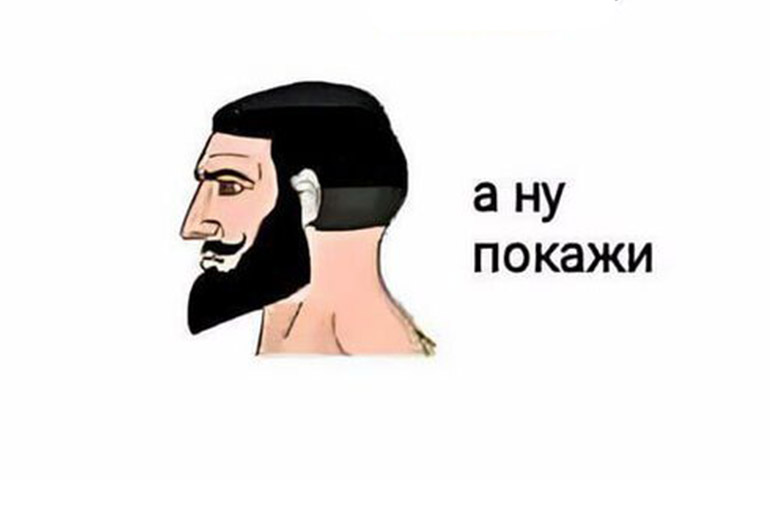
The character in the image belongs to the Yes Chad family — a drawn figure who, in memes, usually accepts a controversial statement without any embarrassment. In a later comic, Trad Girl was added alongside him, and a conversation started between them about requirements for a partner and what each person can offer in return. By the end of 2023 such two-sided dialogues were spreading on English-language social media; the Russian line "Go on, show me" became a separate variant in 2024.
In this version only the man's line and his expressive pose are kept. There's no second panel with the woman's reply, so this isn't the full dialogue but a reaction fragment. It can round off the author's own joke: the character doubts the claim but is ready to put the promise to the test.
Why four words are enough
"Show me" shifts the conversation from self-promotion to demonstration. If someone claims to have a rare skill, an achievement, or an unusual object, the short challenge raises the bar: now the reader expects visual proof. The character's serious face makes the line sound like an order, though it's usually just playful curiosity.
In the full format, one side's high demands often collide with the other side's comically modest offer. The "go on, show me" moment creates yet another twist: the laughably modest quality suddenly turns out to be appealing. This mechanic parodies selection criteria and overconfident claims rather than offering universal relationship advice. The surprise matters more than the specific roles of the characters.
In the English-language versions this exchange was often built as a conversation about requirements for partners: first one side lists the qualities they want, then the other asks to see their own advantage. The Russian line became a standalone reaction fragment and can appear without the whole backstory. So the drawing shouldn't be described as the complete original comic.
From a modest skill to a strange trophy
You can write "I can assemble a wardrobe without the instructions" on top, with the character below calmly replying, "Go on, show me." The joke transfers the challenge into a domestic scene: the claim sounds useful, but the reader understands the proof might take the whole evening and leave extra parts over.
The same works with "I have the perfect list of movies for a rainy day" over the same line, "Go on, show me": instead of a long discussion, the character asks for the result to be produced. The comedy depends on the list owner's confidence and the respondent's seriousness; if the list really is good, the line unexpectedly turns into genuine approval.
The comic is easy to continue with short replies, but the invented example shouldn't be attributed to real men or women. In the original format the roles changed from post to post; the viewer mainly reads the shift from demands to an unexpected confirmation. If the image is cropped to a single frame, it's more accurate to call it a reaction within the trend rather than the complete character story.
Fitting the line to the situation
In a chat, the image can be sent in reply to a boastful message about a collection, a recipe, a skill, or a discovered life hack. Since it doesn't contain the whole story, the reader easily connects it to the preceding message. In a standalone post, it's worth giving a bit of context before the picture: that way it's clear exactly what the character wants to see.
The original format sometimes leans on gender stereotypes about a "demanding girl" or a self-satisfied man. These are easy to drop, leaving just a joke about anyone who promises to impress an audience. Don't reduce the humor to mocking appearance or a real partner — a specific, funny claim and a confident "prove it" work better.