What's shown in the picture
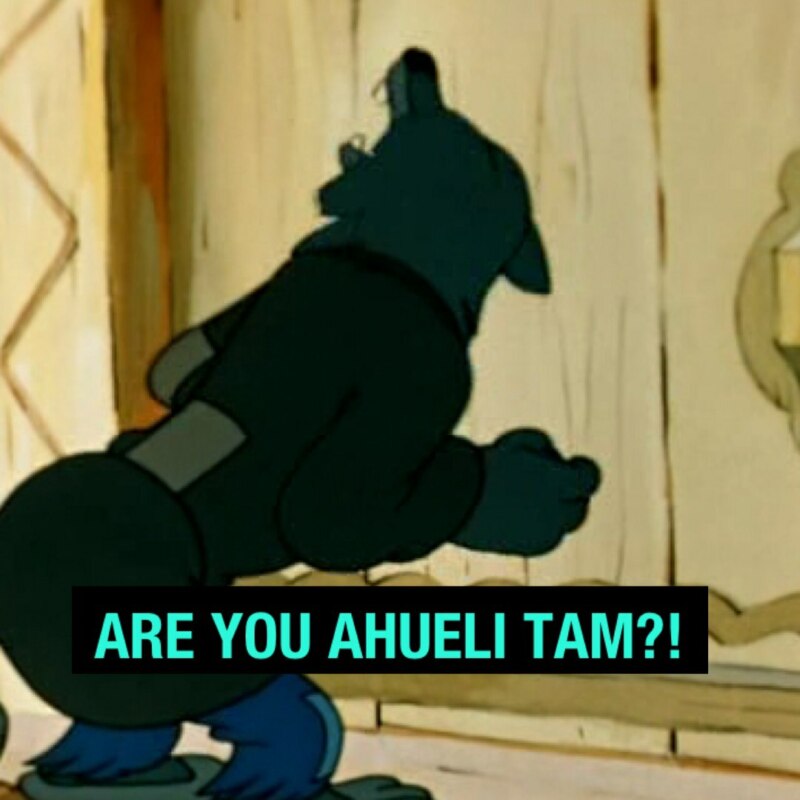
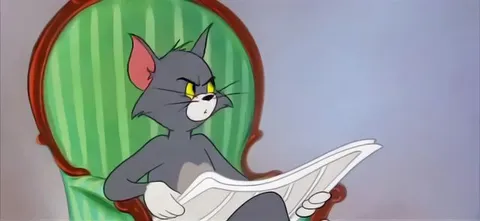
The frame shows a wolf from a Soviet animated film, shot from behind and slightly above: he's standing on his hind legs by a wooden wall, leaning toward something outside the frame. The dark silhouette, blue paws, and muted yellow tones are typical of old hand-drawn animation. At the bottom there's a black bar with turquoise text reading ARE YOU AHUELI TAM?!, which is what turns an ordinary frame into a meme.
The phrase itself is a pseudo-English question with a Russian profane root. It's usually translated as "are you all out of your mind over there?", and it's exactly this gap between the English form and the crude meaning that creates the basis of the joke. The picture works as a standalone frame and doesn't need a full comic strip: the caption sets the tone, and the cartoon scene serves as context that's clear to any Russian-speaking viewer.
Origin: a reworking of a children's fairy tale
The phrase appeared in an adaptation of the fairy tale about the wolf and the seven little goats, in which the wolf shouts "Are you ahueli tam?!" According to the sources' description, the plot combines elements of "The Three Little Pigs" and "Little Red Riding Hood," and the characters address each other in crude slang. The origin of the word "ahueli" itself isn't explained in the sources, and the original source of the phrase couldn't be established.
The first versions appeared in the "Degradach" community on VKontakte. It was run by an author using a pseudonym that translates roughly as "Babai the Magnificent." He called his approach "neo-memeology" and viewed reworkings of classic fairy tales as a way to raise the level of content on the social network. One version, a fairy tale about Cinderella, appeared in the Facebook group "Memes and Fans," and the format itself quickly became a separate genre not tied to one author.
How the joke is built
The format's main device is a bilingual collage. Russian words get English endings — for example, "kozlyatki" (the little goat kids) becomes "kozlatkis" — and the text is written in transliteration. Only a reader familiar with both languages can understand such a caption, and that requirement itself becomes part of the humor: the joke is aimed at those who spot the language trick at first glance.
The second layer of the joke is the contrast between the gentle children's source and the crude language. Characters familiar from childhood suddenly use foul language, and the shock of recognition heightens the comedy. The format usually uses individual frames that illustrate everyday situations: irritation at a coworker, an absurd news story, another plan falling through. The caption turns a familiar scene into a sharp retort, which is exactly why the frame carries over easily into any context.
Spread
The format quickly spread across VKontakte and Facebook, where users reposted and reworked the original frames. The "Degradach" author complained that some of the reworkings looked far below his own work, which shows well how quickly a meme slips away from its original creator. Other people's versions start to live their own life, and the phrase's recognizability grows.
The phrase also went beyond the Russian-speaking audience. English-language services got T-shirts with the slogan, GIF reactions, and image generators. In this sense, the meme became an example of how an inside Russian joke becomes understandable to foreigners through visual language and a short caption, even if the exact meaning of the words stays out of their reach.
Typical use
"Are you ahueli tam?!" is usually used as a reaction to absurd news, a poor decision, or a blatantly stupid argument. The caption works as an ironic exclamation: the speaker simultaneously shows astonishment and mocks the situation. Sometimes it's simply posted in response to someone's out-of-place remark, with no further explanation.
The format requires neither context nor knowledge of the fairy tale's plot, so it's convenient to use in discussions and chats. The cartoon frame is recognized immediately, and the caption sets the tone. It's precisely this ease that makes the format durable: it can be applied to almost any situation where one wants to express a mix of bewilderment and irritation.