What's in the picture
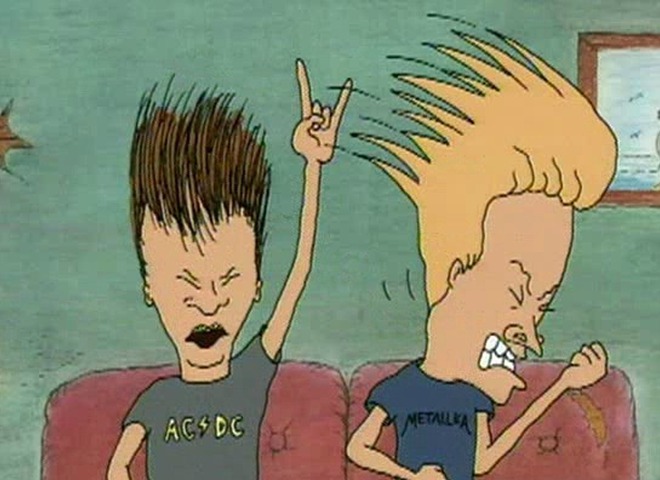
The shot shows two cartoon teenagers sitting on a red couch against a turquoise wall. On the left is a character with spiky dark hair, who's raised a hand in the classic rock-fan gesture, index finger and pinky up, with his mouth open in a grimace. He's wearing a T-shirt with the AC/DC logo. On the right is a tall blond with a bushy, tousled hairstyle, in a blue T-shirt that reads Metallica, squinting and laughing with his mouth wide open.
The gestures, the band-logo T-shirts, and the tousled hairstyles form the characters' visual code. The T-shirts reference their love of heavy rock, which the series turns into a parody of teenage subculture: the characters seem to choose their music for status rather than out of genuine love for it.
Creator and show history
Beavis and Butt-Head first appeared in the late 1980s in short films by Mike Judge, creator of "Office Space" and co-creator of "King of the Hill." The characters debuted in the animated short "Frog Baseball," and in 1992 two pilot episodes aired on the channel Liquid Television. Judge himself voices both characters.
The series premiered on MTV on March 8, 1993, and ran until 1997, becoming one of the channel's highest-rated shows of that period. In 1996 a feature film was released, grossing more than 60 million dollars. The series was later revived: in 2011 on MTV, then on Paramount+ and Comedy Central, where a new season aired in 2025.
The series was also the subject of public controversy. In 1993, the family of a child linked its episodes to a tragic fire in Ohio, though these accusations were later disputed, and MTV changed the show's airtime. For the meme's history, something else matters more: the characters' images became a symbol of a generation that mocked adult authority.
Origin of the meme
Beavis and Butt-Head's life as a meme doesn't begin with a single frame, but with a stable set of traits: the signature chuckle, the snide comments, and the total indifference to consequences. These traits translate easily into pictures, since just two characters on a couch are enough for the viewer to instantly understand the mood. The specific first image that became the meme is not known.
Over time, the characters' images started being used as internet captions, where they comment on events with their usual sarcasm. The shots passed between forums, blogs, and chats, and in the Russian-language segment the characters became known by the nickname "Baklan i Pelmen," which became a joke in its own right.
Typical use
The picture is most often used when someone says something obviously stupid or makes a deliberately pointless remark. A user posts a shot of Beavis making the rock gesture, or of Butt-Head laughing, and the caption works as a comment: "well, that was smart," "I'm thrilled," "everything's under control."
There's also an emotional meaning: the image of "idiots" who don't care about anything fits for describing boredom, apathy, or a joking kind of resignation. The AC/DC and Metallica T-shirts add irony: the characters seem to take pride in serious music they themselves don't actually understand.
Why the meme works
The key mechanism is the contrast between the characters' outward confidence and their inner emptiness. They see themselves as cool, quote rock stars, and look like rebels, but their rebellion is meaningless, and the viewer laughs at that gap.
The second reason is visual recognizability. The angular animation style, the raised finger, and the tousled hairstyles instantly stand out in any frame. That's exactly why the meme has endured for decades: it needs no explanation for anyone who's seen the show, and for new generations it works as a ready-made template for irony.