What’s in the picture
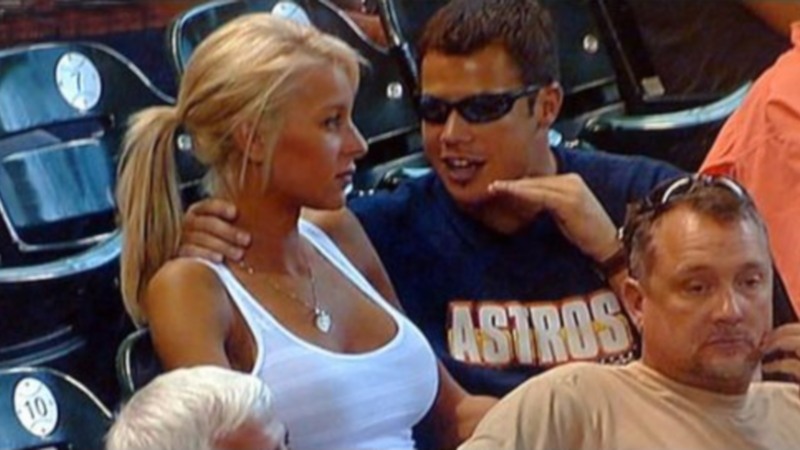
The shot was taken in a stadium stand: seats with numbers are visible in the background. A young man in dark sports glasses and a T-shirt with the word “Astros” leans toward a girl with a light ponytail, one arm around her shoulders, gesturing with the other hand. The girl looks forward and does not meet his gaze. In the foreground sits a man in a beige T-shirt with glasses pushed up on his forehead and a gloomy expression; he involuntarily becomes a third spectator of the scene.
This is not a still from a film and not a staged shot, but a chance moment from a match broadcast: it is exactly this “overheard” realism that makes the picture convincing. The names of the people in the frame are not reliably confirmed, and there is no need to name them, since the joke does not depend on who they are.
Where the photo came from
According to reviews, the image appeared during the game between the St. Louis Cardinals and the Houston Astros on June 7, 2011: the cameras of the TV channel broadcasting the game caught this pair in the stands, and the next day the photo was posted on one of the sports blogs with an ironic caption about a rich dad and the companion’s “stories.” The author of the shot is unknown.
For a long time the photo lived as a rare sporting curiosity. Its real second life began in March 2020, when it was turned into a template: a guy “explains” niche things (the plot of a game, the differences between music genres, how a device works) while the listener doesn’t believe him or is bored.
How the joke works
The meme rests on the contrast between two poses. On the left (or on top) is enthusiasm: gestures, a leaning body, a confident tone that can be read even without sound. On the right is polite but obvious indifference. The viewer easily recognizes both roles, because everyone has been on one side or the other at least once.
The caption usually splits into two parts: what exactly is being explained, and how it is perceived. The narrower and more unexpected the topic, the funnier it is. It doesn’t work if the topic is obvious to everyone, or if the joke boils down to “men vs. women”: strong versions play precisely on enthusiasm and awkwardness, not on the gender of the interlocutors.
Caption examples
Variants invented for this article. He: “Look, this isn’t just a board game, it has an hour and a half of rules.” She: looks at the stands. A joke on the scale of explanations.
He: “There are actually three different ways to brew coffee, and only one of them is the right one.” She: “I just want a drink.” The contrast between knowledge and need. Another variant: he is “a developer explaining how his code is structured,” she is “a manager who wants to know when it will be ready.”
And one more format: “What I thought I was explaining” and “What they actually hear.” This emphasizes how far the listener is from the topic. Often the juxtaposition of “my topic” and “their topic” works: a person enthusiastically talks about a computer’s configuration, while the listener hears only a jumble of letters and numbers.
Usage tips
Choose hobbies you yourself don’t mind digging into for the template: self-irony is always kinder than mockery of someone else. Hobbies, games, gadgets, music and fan theories all work well.
The caption should be short: the topic of the explanation plus the reaction. Do not add what is not in the frame. Words about relationships, romance or the characters of the people are not needed; they add nothing.
It is convenient to build the caption on the scheme “topic, reaction”: on the left a long, detailed explanation, on the right a short “uh-huh.” It is even better when the explanation sounds emotional and the reaction is neutral, because then the difference in level of engagement is visible. If the template is made as two panels, let the second one be funnier than the first.