What's shown in the picture
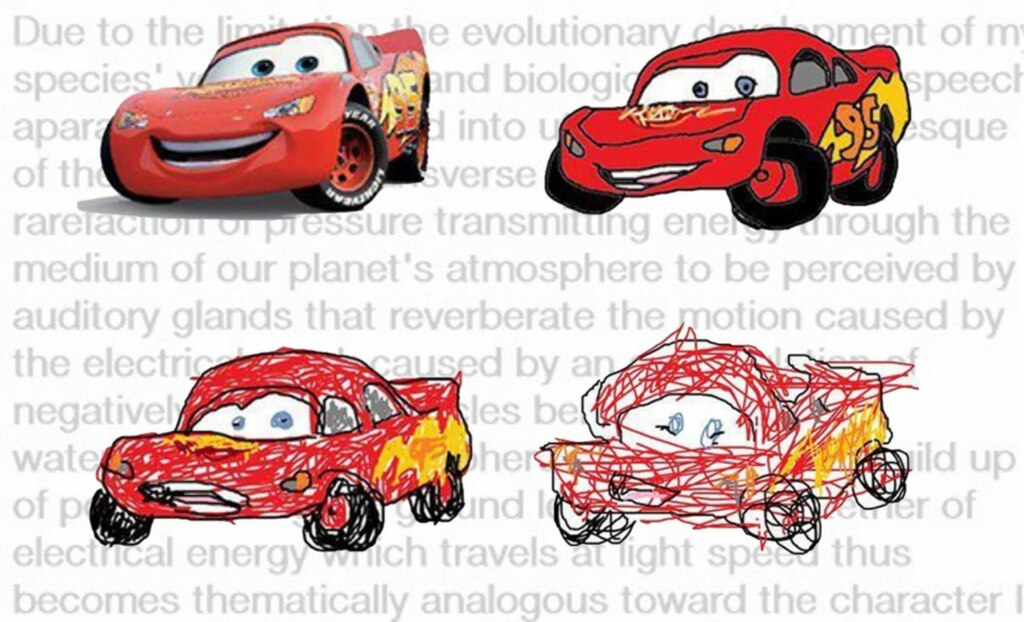
The image shows four drawings of the race car Lightning McQueen from the Pixar animated film "Cars" (2006). The first frame repeats the recognizable official look, with big headlight eyes and a wide smile. In each subsequent frame the outline gets rougher, and in the last one the lines turn into chaotic scribbling.
The background is large, semi-transparent pseudo-scientific text about the vocal apparatus, pressure differentials, and electrical energy traveling at the speed of light. The speech sounds ever more weighty as the drawing loses its features, and it's exactly this gap that constitutes the essence of the format.
Origin and history
The author and exact date of the first comic in this series haven't been established. The format is dated to roughly 2016, though no reliable data on its first appearance has been found. Such pictures are usually published on forums and in themed communities, where they get reposted without credit to the author, making it hard to trace the original source.
The device is linked to a long-standing internet pastime: a drawing gets redrawn in a cycle until the copy loses all resemblance to the original. Here, a second layer has been added to this degradation, a wordy text that grows in the opposite direction. Hence the name, tied to that verbosity. So discussion of the format rests more on observations of its spread than on a known starting point.
How it's used
A typical caption or background text is a long phrase resembling an excerpt from a scientific article or a technical manual. Users change the character, but the rule stays the same: the drawing degrades while the speech grows heavier and longer.
The format is well suited for parodying convoluted explanations and answers that sound smart but say nothing. The verbosity here doesn't serve to clarify the topic but to show off the speaker's vocabulary.
Such pictures are often posted in comments as a reply to a difficult question or as irony aimed at one's own wordiness. Sometimes other recognizable characters are used in the comic: what matters isn't the specific character but the noticeable gap between the drawing and the text. In local versions the caption is often rewritten to fit local realities, while keeping the main device: a mismatch between image and speech. Thanks to this flexibility, the format has gone through several waves of popularity and remains a ready-made template for any character.
Why the meme works
The humor is built on two mismatches. Visually, the familiar character loses its recognizability, as if the viewer is being shown a corrupted copy. In terms of meaning, the speech, which is supposed to clarify, only confuses further: there are lots of terms and little clarity.
Familiarity with the animated film heightens the effect, but it's not required to understand the joke. The meme also serves as a reminder that a long explanation often substitutes for substance, which is why the format transfers easily to any situation where an answer drowns in words.
The format remains understandable even without a caption, because the gap between the drawing and the text is visible at once. That's why it's easy to repeat and adapt to new topics. The format also works as a visual metaphor: the viewer sees a simple drawing break down under the weight of its own text. Such an image registers without explanation, so even a small picture retains its meaning. It's exactly this predictability that makes the scheme convenient to repeat.