An ordinary conversation among sweets
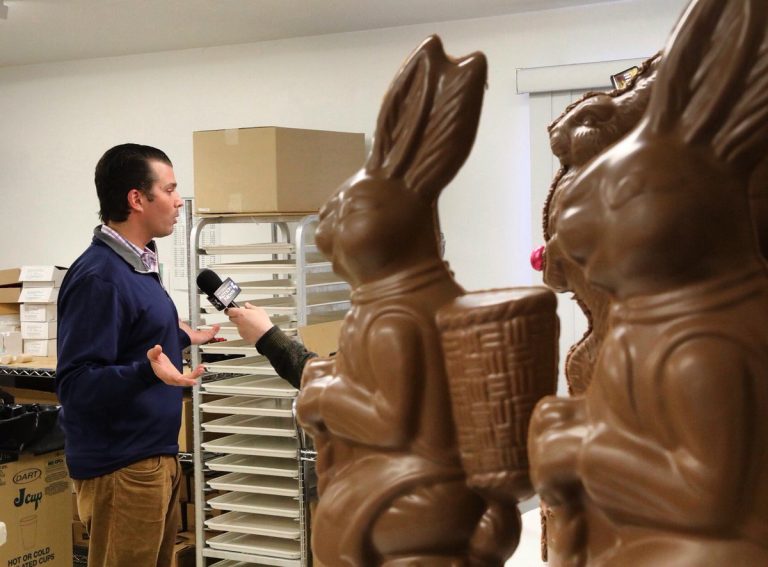
On March 12, 2018, Donald Trump Jr. visited Sarris Candies in Canonsburg, Pennsylvania, during a campaign trip with Republican candidate Rick Saccone. Pittsburgh Post-Gazette photographer Andrew Rush photographed the conversation with a journalist and posted the image on Twitter. The meeting place gave the shot a fairly understandable background: large chocolate figures associated with the Easter season stood all around.
Whose hand peeks out from behind the bunny
Trump Jr. stands on the left in a blue sweater and light brown trousers, turned toward his interlocutor with palms open. On the right in the foreground are the huge chocolate bunnies. Behind the central figure a person is hidden; from behind it, a hand is visible holding out a microphone. Shelves of trays and boxes in the background remind us that the conversation takes place at a production facility.
The hand appears almost where the viewer might expect the figurine’s paw. The reporter’s head is covered, so the familiar interview scheme is reconstructed incorrectly: the person with the microphone seems replaced by a chocolate character. The figures closer to the camera look larger than the interlocutor and form nearly a whole press pack. The photo itself contains no drawn speech by the bunny; this conversation arises from the angle and from the reading that follows.
The bunny becomes a participant in public conversation
After publication, the photo quickly accumulated captions that attributed questions and political interests to the sweets. Trump Jr. also reacted to the joke, presenting the bunny as a persistent interviewer. Thus the meme developed not only through image editing: new imagined lines could be added to the original photo while the successful angle was preserved.
The famous interlocutor makes the situation more noticeable, but understanding it does not require knowing the content of the campaign trip. The serious pose of the speaker and the professional microphone establish the genre of public conversation. The chocolate ears and basket break this genre without destroying the composition. The result is a scene in which everything looks ordinary except the most unexpected participant: the interviewer turned out to be edible.
Why the angle replaces photo editing
The image offers two compatible versions of one space. In reality, the reporter stands behind the figure; in the joking version, the microphone belongs to it. The second version holds precisely because the extra details are hidden and the necessary ones remain in view. The viewer is given enough signs to recognize an interview, and the real journalist’s face is removed, which would immediately break the illusion.
The Easter treat also acquires a ready-made character for new captions. It can worry about temperature, shelf life or the fate of the chocolate. These questions have nothing to do with the real conversation, yet they suit the invented interviewer. The more serious the phrasing, the more convincing the fantastic situation seems for a moment, and the stronger the comic clash with the ordinary production background.
Three questions from the chocolate press
For example, the bunny could demand an explanation of why the temperature in the room was raised again. Words about production safety turn into the personal anxiety of a figure who risks melting. The interlocutor’s open palms look like an attempt to calm a particularly interested journalist.
Another imagined caption would have the bunny ask whether people will eat the ears first or keep them until the end. A customer’s everyday habit is presented as a matter of principle and public concern. The microphone gives it an official scale, although the whole conflict exists only within the new text.
A third variant would make the figurine a representative of chocolate, outraged at the rising popularity of caramel. The question of competition becomes a dispute between two kinds of sweets, while the real person takes the role of arbiter. In all three scenes the viewer first accepts the serious form of an interview, and then remembers that the demanding correspondent is standing on a counter and made of chocolate.