What is in the picture
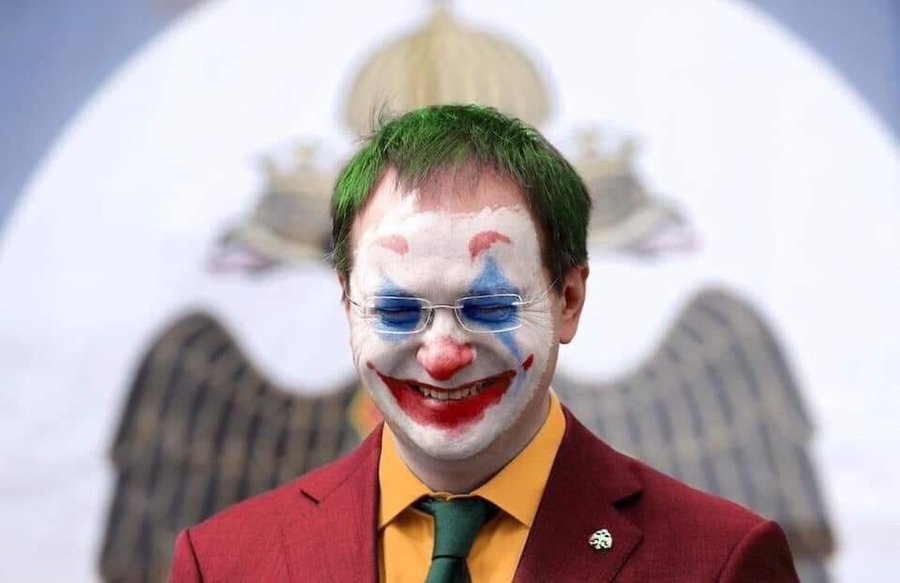
The image is a photomontage: onto a portrait of a man in glasses, a red jacket, a yellow shirt and a green tie are superimposed green hair, white clown makeup, blue diamonds around the eyes and a wide red grin, like the character in the film “Joker.” Behind him is a blurred double-headed eagle. The man’s eyes are closed; he is laughing.
The montage is put together as a reaction to a quote: the image of a clown is attached to a topic where the word “Joker” was uttered by an official. Who exactly the portrait depicts and who made the montage cannot be determined from the picture itself.
Where the phrase comes from
In the autumn of 2019, Todd Phillips’ film “Joker,” starring Joaquin Phoenix, came out in Russian cinemas, and in November it became known in St. Petersburg that a young woman had been murdered, a crime attributed to the historian Oleg Sokolov, a lecturer and specialist in the Napoleonic era. The story caused an enormous public outcry.
On November 14, 2019, as the media reported, Medinsky said: “Earlier everyone asked about ‘Joker,’ now about Oleg Sokolov. You really want to answer: if you like ‘Joker’ so much, why don’t you like Oleg Sokolov?” According to a retelling of his subsequent interview, he meant to point to the sensationalism of the coverage and to the fact that a fictional villain provokes less sympathy than a real one. The minister himself explained his words exactly this way; readers saw a mismatch in them.
Why the phrase became a template
The main objection is that a fan of the film and a supporter of the criminal are placed in one row here. A viewer can be captivated by the acting and the hero’s story and still not approve of his actions: that’s basic to how we watch films. The phrase is built as a trap: “If you like A, why don’t you like B?” even though A and B have nothing to do with each other.
It is precisely this construction that proved convenient. It can be applied to any pair where a conclusion supposedly follows from a premise but in fact does not. The meme became not a specific topic but a logical move, and the template lives on without any link to its original source.
Examples for your own caption
“If you like ‘Nu, Pogodi!’ so much, why don’t you like a trained wolf?” — fictional versus real, but completely harmless.
“If you like pies so much, why don’t you like the baker on your street?” — a substitution of an absurd pair.
“If you like ‘The Master and Margarita’ so much, why don’t you like the black cat on the tram?” — the literary version.
“If you like vacations so much, why don’t you like the Monday after one?” — the everyday version, with the logic of “the narrator catches himself.”
How to use it and where to stop
It works best with a short question about two mismatched objects. The more serious the intonation, the funnier it is. Do not use the template for jokes about real victims or for comparisons with real crimes: the original story is tied to a person’s death, and the meme rests on a logical construction, not on that event.
If a picture with clown makeup is used as an illustration, the caption should be about the manner of reasoning itself, not about the person in the photo.