What the picture shows
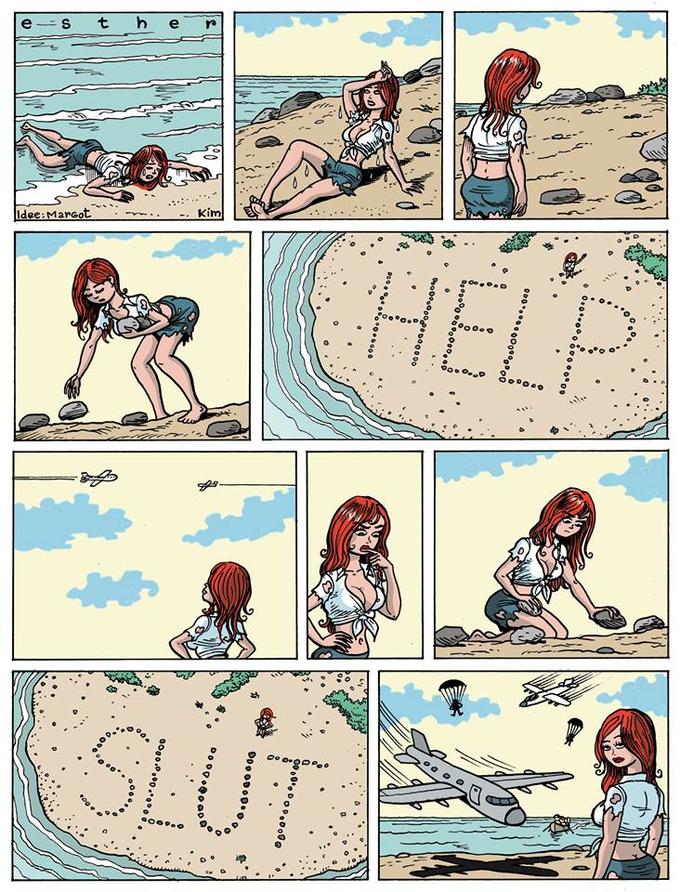
The comic panels show a red-haired girl named Esther, washed up by the waves onto the shore of a desert island. She looks around, sees no one nearby, and starts spelling out the word "HELP" in stones on the sand, so it is visible from above. A plane flies past without noticing the message. In the next panels, the heroine breaks up the word and lays out a new one instead: "SLUT" (a derogatory English slur for a sexually promiscuous woman). Right after that, a plane appears in the frame along with rescuers parachuting down to rush to her aid.
Origin: the comic "Esther"
The panels come from the comic "Esther": the title panel credits "Margot" (idea) and "Kim" (art). The comic follows the tradition of Franco-Belgian humor series aimed at adult readers and is built on the contrast between the red-haired heroine's naive look and witty, often sarcastic plot twists.
The island-sign storyline became the most widely shared page of the comic online starting in the mid-2010s, when the panels began circulating en masse as screenshots and GIFs, separated from the rest of the comic and without the character's name or the authors' credits. That is how the meme-culture name "Esther Help Sign," after the heroine, stuck.
Meaning and logic of the joke
The humor is a satirical observation about how attention works: a polite, literally accurate request for help ("HELP") is ignored by a passing plane, while a provocative word that is self-destructive in meaning brings rescue instantly. The format reads as an ironic comment on how scandalous or provocative content spreads and gets noticed more readily, in media and online, than a neutral or polite appeal does.
How the format is used in memes
The panels are used as a reaction template in situations where something "decent" gets no attention while something provocative or scandalous gets it instantly. Captions are adapted to the specific context. For example, a user posts a screenshot captioned "me: ran a quality-content channel for two years, 10 subscribers," followed by a second panel, "me: wrote one scandalous tweet, 10,000 retweets." Or the panels are used as-is, with no caption, as a reply to someone else's post about low audience engagement.
Because the panels carry almost no text (apart from the word in the sand), the format adapts easily to any topic, from social media and marketing to everyday situations where the "proper" way of asking for something doesn't work, but a provocative one works right away.
Place in meme culture
"Esther Help Sign" belongs to a durable category of comic memes, where individual panels from little-known Franco-Belgian or Japanese comics are pulled out of their original source and start living on their own as universal reaction templates. As with similar formats, most people who repost these panels don't know the character's name, the comic's authors, or the original publication context; all that matters to them is the visual metaphor itself: "provocation works better than a polite request."