How a scene from the show became a template for waiting
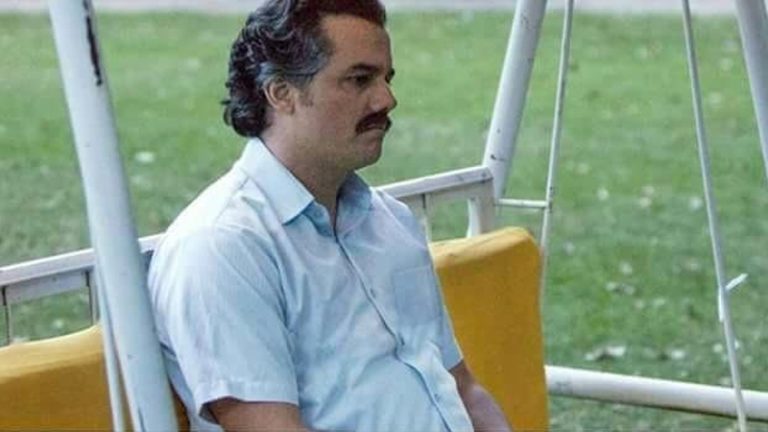
In “Narcos,” Wagner Moura plays Pablo Escobar. The second season of the Netflix series premiered on September 2, 2016, and by autumn the frames with the pensive character had started living separately from the criminal storyline. As early as October, there were compilations of several scenes in which Escobar was left alone. They conveyed the pause so clearly that the caption only needed to name an event that would never arrive.
Among the early known uses was an October post on Reddit about waiting for a OnePlus 3 delivery. In 2017 the format returned in jokes about the time until the next episode, and in early 2018 it got a notable wave with stories about absent coworkers and lunchtime solitude. This is a sequence of surviving traces of distribution, not proof of a single first meme. Russian-language captions also moved the waiting into the most ordinary everyday circumstances.
One man on a garden swing
This version contains one horizontal frame. Moura sits on a yellow swing seat with a white frame and chains. He wears a light blue short-sleeved shirt; his face with a mustache and curly hair is visible in profile. Behind him is green grass, with no other people nearby. The picture contains no three-panel sequence, pool, or separate table, which sometimes appear in other versions of the template.
Garden swings are associated with rest and unhurried conversation, yet here the entire space belongs to one motionless figure. The surrounding area does not look filled with events. His gaze is directed to the side, and the character does not address the viewer with any active gesture. That is why the frame is easy to read as a stretched-out pause.
How stillness depicts a long time
The joke offers a small scene where an action should have begun, but the hero is still waiting. The caption sets up the promised event, while the image shows a person with nothing to fill the gap. Even a single frame can convey duration: a relaxed pose, empty space, and the absence of a companion make the viewer mentally continue this state for several more minutes or hours. Multi-frame compilations strengthen the same effect through repetition.
The gap in scale matters too. A viewer familiar with the series sees a man from a dangerous criminal story, but the caption can send him to wait for friends after school or for a game to load. A large dramatic figure gets a small everyday problem. The meaning does not reduce to sadness alone: sometimes the hero is simply left to himself, sometimes excluded from a shared activity, sometimes patiently waiting. It is the caption that chooses the nuance, which in a calm image stays open.
Three new pauses for Escobar
Imagine a group that starts a board game, but each player in turn leaves for tea, cookies, and a phone charger. The caption “The one who already laid out the cards” turns the swing into a place of waiting for the first move. It's funny that the hero did all the preparation and now turned out to be the only person with nothing to do. His stillness is explained by the others' absence, not by an unwillingness to play.
Another scenario: a chat announces a joint movie night, and after discussion it turns out everyone picked different films. The frame suits a person who has already hit pause and is waiting for the group's signal. A third example: an app promises to tell you when your finished work can be picked up, but every new notification turns out to be an ad. Escobar here embodies waiting for one needed message among many unneeded ones. These captions change the object of waiting while preserving the characteristic emptiness around the character and the absence of a moment that would finally shift the situation.